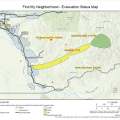
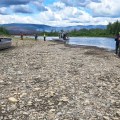
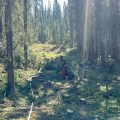
Higher temperatures, lower humidity, and winds increased fire behavior yesterday on the Ninetyeight Fire (#218), burning north of the Salcha River. The fire was most active on the western edge and in the southwest corner, with some backing and torching. Some flareups were observed in the interior of the fire perimeter, though not on the side of the fire near the river. There was some movement to the west, where a large smoke column was visible.
BLM Alaska Fire Service
Increased fire activity expected today across the Ptarmigan Complex
A Red Flag Warning has been issued for today due to a forecast calling for high temperatures, low humidity, and wind. These conditions are expected to cause increased fire activity and smoke across the Ptarmigan Complex as fuels become more receptive to fire and hotspots begin to show themselves.
Line around Otter Fire reinforced; Fortymile Fire 10% contained
Twelve smokejumpers and a helitack crew identified and worked to suppress any potential threats Tuesday to the containment line around the Otter Fire (#344). The fire is fully contained. Firefighters plan to remain in place through this week’s Red Flag conditions so they can take action if the fire begins to flare up.
Firefighters prepare for tactical shift across Roundabout Complex as forecasted conditions favor direct attack
Crews are beginning to pivot tactics on key fires across the 14,302-acre Roundabout Complex, as weather conditions shift this week. While some areas remain in monitor status, active fires are seeing continued prep, securing, and mop-up operations. A period of drying followed by light precipitation is improving access and revealing fuels, creating opportunities to adjust strategies where conditions allow.
Firefighters on the Lush Fire continue making progress protecting Rampart
The Lush Fire (#199) is located one mile northwest of Rampart, just across the Yukon River. The fire behavior yesterday was creeping and smoldering with isolated torching. The weather forecast calls for increasing temperatures through the week which will likely cause an increase in fire behavior. There is no chance for precipitation in the upcoming forecast.
Minimal fire behavior observed on the Ninetyeight Fire
Yesterday the Ninetyeight Fire (#218) received light precipitation and showed limited fire activity; creeping and smoldering, but no torching. Helicopter bucket drops were again used to cool hotspots on the southwest corner of the fire. The eastern front of the fire is looking good, without much fire activity. The fire perimeter is approximately 5,028 acres in size.
Ptarmigan Complex firefighters continue to prepare for Red Flag conditions
The National Weather Service in Fairbanks has issued a Red Flag Warning for Wednesday due to a forecast that calls for hot, dry weather and windy conditions. In preparation, firefighters assigned to the Ptarmigan Complex worked over the past several days to reinforce saw lines and improve protection for Alaska Native allotments and other values at risk.
Otter Fire contained, not controlled; Fortymile Fire gets hotshot crew
The Otter Fire (#344) about 50 miles northeast of Venetie is fully contained but not controlled. A dozen smokejumpers also continue to fight the Fortymile Fire (#355) near Fortymile Creek about 25 miles northwest of Beaver.
Roundabout Complex firefighters complete key objectives and shift to priority areas as drying trend approaches
Firefighters are making steady progress across the Roundabout Complex, with several crews completing key suppression objectives and being repositioned to priority areas. With a warming and drying trend on the horizon, fire managers continue to adapt strategies to stay ahead of changing conditions and protect values at risk.
Crews continue making progress on Ninetyeight Fire
On Sunday, helicopter bucket work continued on the north side of the Ninetyeight Fire (#218) to cool hotspots where fire behavior was active, including the northeast side where fire was backing towards the north in one section with creeping, smoldering, and some torching in the hills of military land to the north. Heat was observed in pockets but was not continuous. Fire behavior was not very active on the southern side.