Crews continued to battle the Ninetyeight Fire (#218) yesterday as extreme fire weather persisted for a third consecutive day. Winds and low relative humidity threatened established fire lines. Firefighters on the southwest corner, from Mile 33 to Mile 35 along the Salcha River, engaged the fire directly while bucket drops and scoopers supported containment efforts. Although the fire spotted outside the firebreaks a few times, firefighters, assisted by helicopter drops, successfully extinguished these spot fires.
Ninetyeight Fire

Public asked to avoid Yukon Training Areas 315-318 as Ninetyeight Fire crews conduct infrastructure protection
High heat and low humidity contributed to active fire behavior on the Ninetyeight Fire (#218) yesterday, with another significant push to the north and west. Firefighters used direct tactics to protect infrastructure on military land and keep the fire south of Brigadier Road. Due to fire crews working in this area, Training Areas 315, 316, 317, and 318 in the Yukon Training Area (YTA) are closed. For public safety and the safety of fire personnel, please avoid this area until further notice.

Ninetyeight Fire grows towards the north and west; Firefighters gain containment near structures
The Ninetyeight Fire (#218) remained active yesterday under continued hot and dry conditions. It is now 10,544 acres in size, with some growth to the north and west. On the southwest side, the fire is burning in hardwoods, which has moderated fire spread. Yesterday scooper aircraft and helicopters conducted water drops on the southwest corner from Salcha to the boundary of military land to assist hotshots in keeping that portion of the fire in check.

Multiple aircraft respond to southwest spread on Ninetyeight Fire
Yesterday afternoon, strong winds pushed Ninetyeight Fire (#218) approximately one mile to the southwest. Multiple aircraft responded, including water-scooping aircraft and helicopters, dropping water on the new southwest flank near Mile 32.5. The strong aerial support enabled firefighters to prevent the fire from crossing the Salcha River, and no structures were damaged. The fire is now burning in hardwood fuels. Firefighters made solid progress on structure protection in the area, plumbing many cabins for defense. A hotshot crew will continue patrolling nearby structures around Miles 31-32 and improving protection measures, and firefighters will go direct on this portion of the fire today to prevent additional spread.
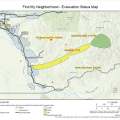
Evacuation levels change on Ninetyeight Fire
Higher temperatures, lower humidity, and winds increased fire behavior yesterday on the Ninetyeight Fire (#218), burning north of the Salcha River. The fire was most active on the western edge and in the southwest corner, with some backing and torching. Some flareups were observed in the interior of the fire perimeter, though not on the side of the fire near the river. There was some movement to the west, where a large smoke column was visible.
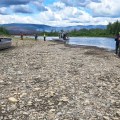
Minimal fire behavior observed on the Ninetyeight Fire
Yesterday the Ninetyeight Fire (#218) received light precipitation and showed limited fire activity; creeping and smoldering, but no torching. Helicopter bucket drops were again used to cool hotspots on the southwest corner of the fire. The eastern front of the fire is looking good, without much fire activity. The fire perimeter is approximately 5,028 acres in size.

Crews continue making progress on Ninetyeight Fire
On Sunday, helicopter bucket work continued on the north side of the Ninetyeight Fire (#218) to cool hotspots where fire behavior was active, including the northeast side where fire was backing towards the north in one section with creeping, smoldering, and some torching in the hills of military land to the north. Heat was observed in pockets but was not continuous. Fire behavior was not very active on the southern side.
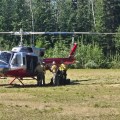
Helicopter water drops cool hotspots on the Ninetyeight Fire
With higher temperatures and north and west winds, the Ninetyeight Fire (#218) saw slight increases in fire activity on Saturday, with some light torching on the southwest side.Helicopter bucket drops were used to cool hot spots near Mile 34, and crews with water pumps, hoses, and saws worked the area and headed west. Crews assessed fire line and continued to mop up hot spots. Crews are nearing completing of preparation work on Alaska Native allotments and are now doing additional mop up to bolster line depth.

Additional crews arrive at Ninetyeight Fire
Additional crews arrived Friday from the lower 48 to work on the Ninetyeight Fire (#218) – the El Dorado Hotshots and the Grass Lake Wildland Fire Module. Though weather was sunny Friday with wind gusts up to 10 mph, no fire growth was observed.
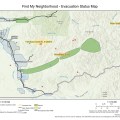
Ninetyeight Fire evacuation level downgraded to Level 1 “READY”; little heat found near structures
Thanks to the strong work of fire crews and cooperative weather conditions on the Ninetyeight Fire (#218), the Fairbanks North Star Borough is downgrading the Salcha River corridor (Upper, Middle and Lower Salcha River evacuation zones) to a Level 1 (READY) alert level.
 Alaska Wildland Fire Information