As Interior Alaska experiences another near-record hot day, firefighters are wrapping up work on some fires and mobiling to more pressing ones near Eagle.
The BLM Alaska Fire Service is mobilizing crews and aircraft to Eagle to tackle the Sinnott Fire (#382), burning about 3 miles northwest of Eagle. The Sinnott Fire, at 800 acres, is burning in steep terrain north of Mission Creek, about 2 miles from the nearest cabin to the southeast. It has been reported as smoldering, creeping, and backing into the wind with some isolated torching.
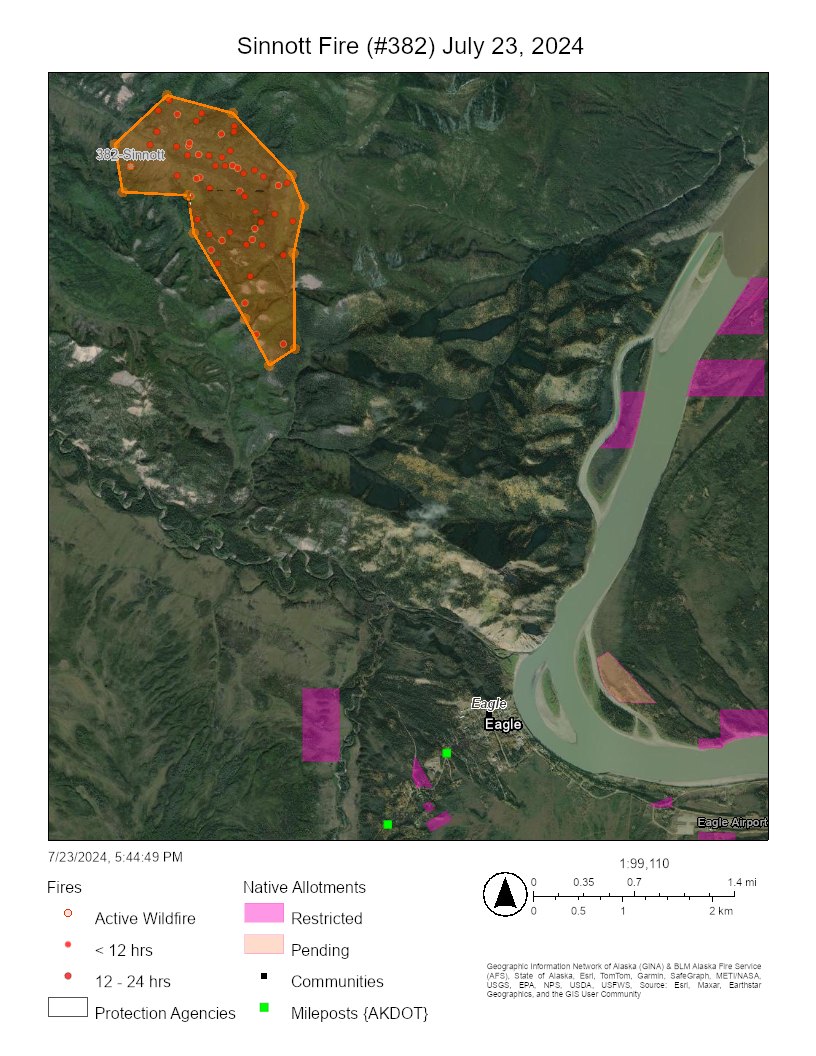
The Yukon Crew and Denali Wildland Fire Module, both Chugachmiut fire teams based in the Kenai Peninsula, will travel to Eagle to assist in protecting properties and town from the large fire burning in steep terrain. Meanwhile, a Division of Forestry & Fire Protection helicopter has been effectively using water drops to keep the Dome Fire (#386), west of mile 117 Taylor Highway, around 2 acres.
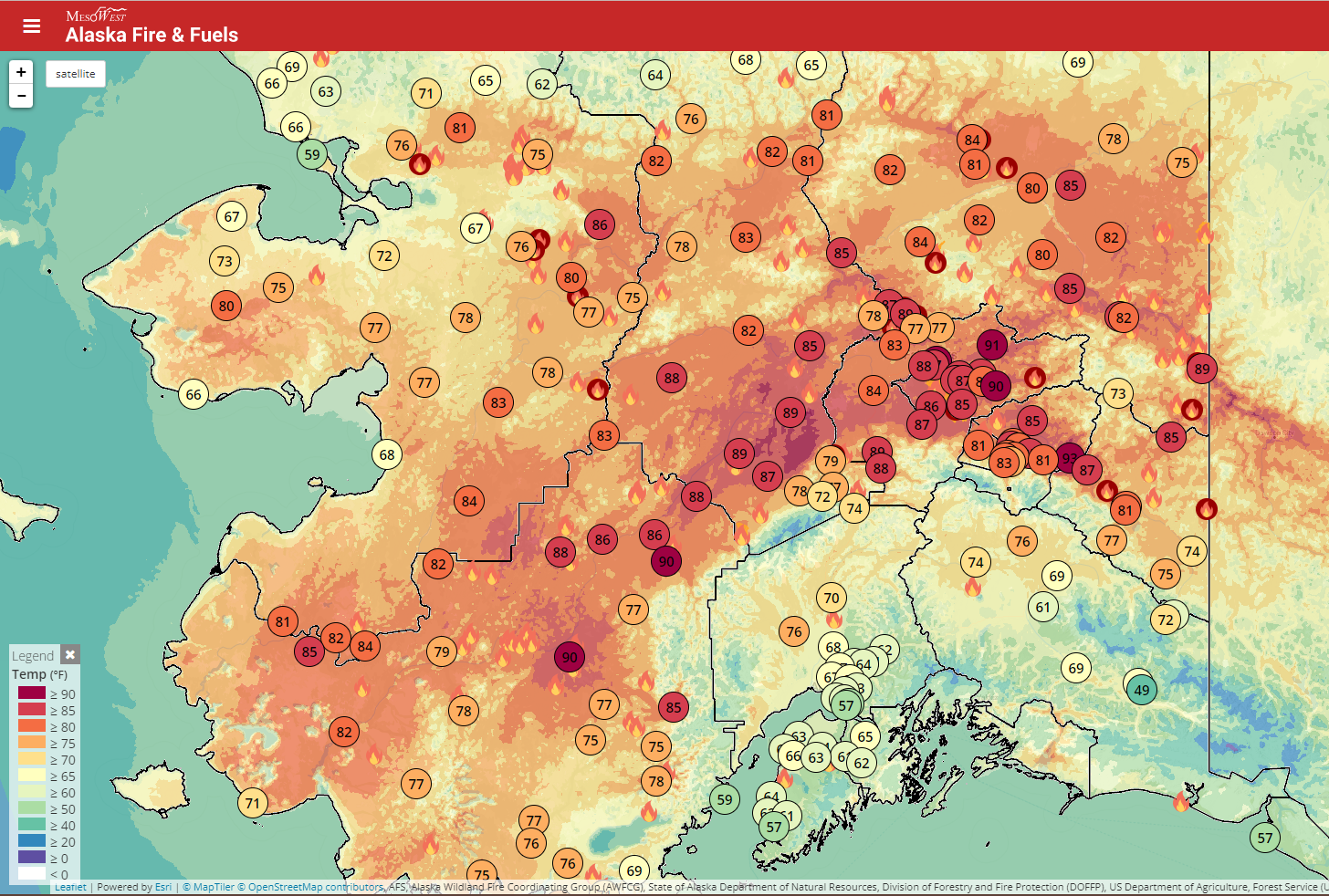
With temperatures soaring to 90 degrees in Eagle Monday and 91 degrees at Angel Creek off the Chena Hot Springs Road Tuesday, firefighters are hoping for a reprieve as a cold front starts to move in from the Bering Sea on Wednesday. This front could bring thunderstorms and rain to much of Alaska, although it’s uncertain if it will significantly impact the driest areas like the Yukon Flats and Tok.
Also on Tuesday, smokejumpers demobilized from two fires outside Venetie have returned to Fairbanks to go back in the line-up for initial response to new fires. The Mooseheart Crew will replace them on the T’eedriinjik Fire (#380), while the Clear Water Crew will help other firefighters mopping up the Marten Fire (#383). They are BLM Type 2 contract predominantly of Indigenous firefighters from rural Alaska communities.
Firefighters contained the Martin Fire burning 23 miles southeast of Venetie Monday night. The T’eedriinjik Fire is burning in a very spotty pattern and is estimated at about 6 acres, down from the original reported size due to better mapping done by firefighters on the ground. Firefighters continue to mop up this fire.
Both the Main Fire (#240) near Ruby and the McDonald Fire (#119) south of Fairbanks have demobilized most firefighters. These fires are now under monitoring status, with a single firefighter remaining as a lookout for the McDonald Fire. While both fires remain active and may produce smoke, they are not currently threatening any valuable sites.
Other fires in remote areas, such as the 22,000-acre Deep Fire (#240) near Lake Minchumina and the 2,000-acre American Fire (#262) southeast of Beaver, have been very active during the recent heat wave. Firefighters are still working on the Grapefruit Complex and the Riley Fire (#318) in Denali National Park, where drone operations continue to monitor hot spots. Firefighters reported the Grapefruit Complex, burning on both sides of the Elliott Highway south of Livengood, received a nice shot of rain Tuesday.
As of 8 p.m. Tuesday, 348 fires have burned approximately 614,000 acres in Alaska.
-BLM-
Bureau of Land Management, Alaska Fire Service, P.O. Box 35005, 1541 Gaffney Road, Fort Wainwright, AK 99703
Need public domain imagery to complement news coverage of the BLM Alaska Fire Service in Alaska?
Visit our Flickr channel! Learn more at www.blm.gov/AlaskaFireService, and on Facebook and Twitter.
The Bureau of Land Management Alaska Fire Service (AFS) located at Fort Wainwright, Alaska, provides wildland fire suppression services for over 240 million acres of Department of the Interior and Native Corporation Lands in Alaska. In addition, AFS has other statewide responsibilities that include: interpretation of fire management policy; oversight of the BLM Alaska Aviation program; fuels management projects; and operating and maintaining advanced communication and computer systems such as the Alaska Lightning Detection System. AFS also maintains a National Incident Support Cache with a $18.1 million inventory. The Alaska Fire Service provides wildland fire suppression services for America’s “Last Frontier” on an interagency basis with the State of Alaska Department of Natural Resources, USDA Forest Service, National Park Service, Bureau of Indian Affairs, U.S. Fish and Wildlife Service, and the U.S. Military in Alaska.
Categories: Active Wildland Fire, BLM Alaska Fire Service
 Alaska Wildland Fire Information