Another short round of warm weather slightly revives some large fires in Interior Alaska as they consume pockets of unburned vegetation
The BLM Alaska Fire Service North Star Fire Crew will spend the last days of this week’s warm spell in Interior Alaska pulling equipment from cabins and fire lines near the McDonald Fire (#119). This 18-member crew was shuttled from the BLM AFS helicopter base at Ladd Air Field on Tuesday. They will spend the next few days pulling water pumps, hose, sprinkler systems, and other equipment left in place for quick mobilization to protect the cabins from the fire burning in the Tanana Flats Training Area southwest of Fairbanks.

Over the next few days, people may see a helicopter sling-loading equipment to a spot near the Salcha River boat ramp, where it will be loaded onto a truck for return to BLM AFS on Fort Wainwright.
This crew, although classified as a Type 2 Crew, is trained and equipped to Interagency Hotshot Crew standards, with overhead filled by BLM AFS hotshots with 3-5 years of fire experience.
The lightning-caused McDonald Fire started on June 8 and quickly grew to 750 acres as wind pushed the flames through black spruce trees on the training range. The fire burned in an area designated for limited management, meaning that unless the fire threatens property or people, it will be allowed to play its natural ecological role. This strategy considers firefighter safety, values at risk, and impacts on the surrounding area.
Firefighters spent weeks on the fire, protecting a cluster of 21 cabins along 5 Mile Creek after they were threatened by the southern tip of the fire as it burned just beyond the military training range boundary. Firefighters conducted burnout operations on the west side of the 5 Mile Creek cabins, and crews continue creating a contingency fireline on the west side of the cabins. To protect military infrastructure, firefighters removed hazardous fuels and installed sprinklers, pumps, and hoses.
What goes in must come out.
Fire managers extended fire response to include the Clear Fire (#204), northwest of the McDonald Fire. The Clear Fire and McDonald Fire merged on June 26 and were estimated to have burned a total of 176,797 acres.
Despite several days of rain in June and August, it wasn’t enough to fully extinguish large fires like the McDonald Fire, the 4,457-acre American Fire (#262), and the 1,000-acre Sinnott Fire (#382) north of Eagle. Another round of warm weather has revived these fires slightly as they consume pockets of unburned vegetation. The American Fire, burning along Preacher Creek 12 miles north of 77-mile Steese Highway, was producing smoke visible to Steese Highway motorists and pilots in the area.
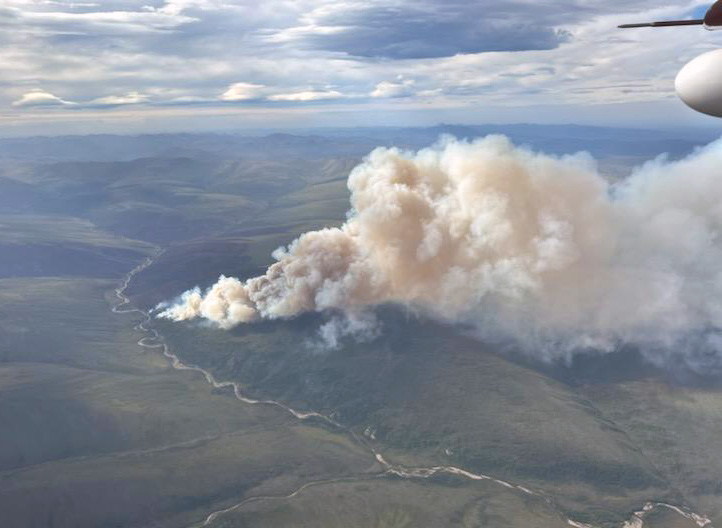
The recent fire activity is likely to be short-lived as another change to cooler, wetter weather is anticipated by Friday.
As of 6 p.m. Tuesday, 357 fires have burned approximately 635,000 acres, with a new fire reported near Glennallen. Numerous Alaska Division of Forestry & Fire Protection resources and local fire departments quickly responded to suppress a small fire just south of milepost 165 on the Glenn Highway.
Contact BLM Alaska Fire Service Public Affairs Specialist Beth Ipsen at 907-356-5510 or eipsen@blm.gov for more information.
-BLM-
Bureau of Land Management, Alaska Fire Service, P.O. Box 35005 1541 Gaffney Road, Fort Wainwright, Ak 99703
Need public domain imagery to complement news coverage of the BLM Alaska Fire Service in Alaska? Visit our Flickr channel!
Learn more at www.blm.gov/AlaskaFireService, and on Facebook and Twitter.
The Bureau of Land Management Alaska Fire Service (AFS) located at Fort Wainwright, Alaska, provides wildland fire suppression services for over 240 million acres of Department of the Interior and Native Corporation Lands in Alaska. In addition, AFS has other statewide responsibilities that include: interpretation of fire management policy; oversight of the BLM Alaska Aviation program; fuels management projects; and operating and maintaining advanced communication and computer systems such as the Alaska Lightning Detection System. AFS also maintains a National Incident Support Cache with a $23 million inventory. The Alaska Fire Service provides wildland fire suppression services for America’s “Last Frontier” on an interagency basis with the State of Alaska Department of Natural Resources, USDA Forest Service, National Park Service, Bureau of Indian Affairs, U.S. Fish and Wildlife Service, and the U.S. Military in Alaska.
Categories: Active Wildland Fire, BLM Alaska Fire Service
 Alaska Wildland Fire Information