As the fire season comes to a close in Alaska, the BLM Alaska Fire Service has shut down its remote station in Galena. After a busy season supporting 71 wildfires in the Galena Zone – BLM AFS’s farthest west protection zone, about the size of Montana – almost all personnel have either returned to AFS headquarters in Fairbanks, are working on fires in the Lower 48, or have finished for the season.


First photo: Galena Zone Maintenance Worker Bronson Singh, far right, directs Fish & Wildlife Service maintenance workers and carpenters who traveled up from the Lower 48 in 2017 to start construction on what would eventually become the new BLM AFS Galena fire station dining facility. Second photo: Rod Johnson, in the middle, hands rolls of hose to Galena Zone Fire Specialist Matt Kilgriff as part of a supply load bound for St. Mary’s in 2022. Jeff Johnson is walking over with two more rolls of hose. BLM AFS photos
Warehouse workers and maintenance staff, brothers Rod and Jeff Johnson, and Bronson Singh were the last to leave, closing down the station after a very active fire season that kept them busy. Singh ensured everything was in working order this summer, handling maintenance and repairs, while the Johnson brothers managed the flow of supplies, ensuring they were received, organized, and distributed efficiently.
The Johnsons estimated that thousands of pounds of equipment and supplies moved in and out of the Galena station daily – whether coming in from Fairbanks or going out to support wildfires. Since the zone’s 93.5 million acres are roadless outside of remote communities, everything, including people, moves by aircraft. The Yukon Fire Dispatch Center estimated there were 108 flights in and out of the Galena Station and 442 personnel movements through Galena – mostly from AFS headquarters at Fort Wainwright in Fairbanks 269 miles to the east.
It was an exceptionally busy and long season for the station’s kitchen staff and barracks custodians Karen Evans and Bernard Nollner, who supported the influx of firefighting and support personnel assigned to fires and general Zone operations. This included two Lower 48 incident management teams for complexes near Huslia and Ambler.
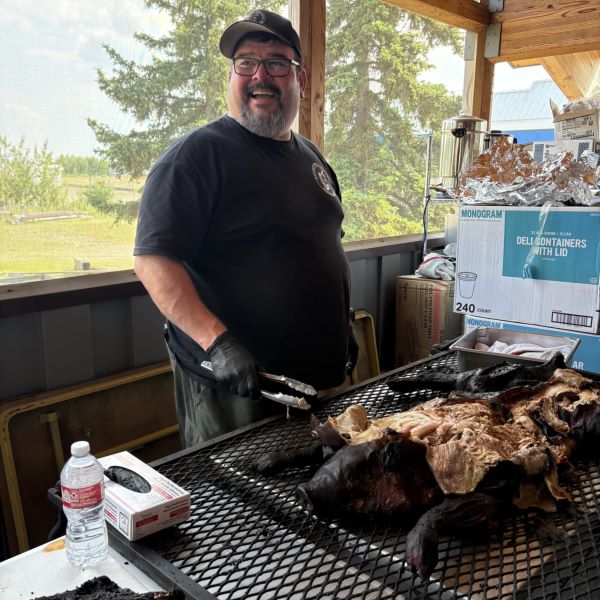


Lead cook Darren Ballentine estimated that the kitchen staff, including Galena resident Sharon Nollner and her daughter Tamera, and sisters Glenis Munguia of Tampa Bay, Fla., and Maritza McCutchen of Chico, Calif., baked more than 10,400 cookies. Galena is renowned for its delicious food, especially its scrumptious chocolate chip cookies (IYKYK, and many do!). With the exception of Darren, the kitchen staff are administratively determined workers hired on an as-needed basis. Bernard and Sharon are brother and sister.
This season was also the first without long-time cook supervisor Ed Haen, who retired last spring. His absence was felt, but the team rose to the challenge and continued the tradition of excellent service.
Ballentine estimates that an average of 80 people were served per meal, sometimes more, with about 30 sack lunches made for those passing through the remote fire station. This includes U.S. Fish and Wildlife Service personnel based nearby in Galena.
“To say it was an epic year is an understatement,” Ballentine said. “I was truly blessed to have those ladies. They went above and beyond and kept a great attitude the whole time.”
Thank you to everyone who made this season a success. We look forward to another year of dedication and hard work in protecting Alaska’s remote communities.
Watch this video to learn more about this remote wildland fire station in the heart of Alaska: https://youtu.be/4ckg8IjEK1M?si=goyw2KkbEyZgQEYq.
-BLM-
Need public domain imagery to complement news coverage of the BLM Alaska Fire Service? Visit our Flickr channel?
Learn more at www.blm.gov/AlaskaFireService, and on Facebook, X, and YouTube.
The Bureau of Land Management Alaska Fire Service (AFS) located at Fort Wainwright, Alaska, provides wildland fire suppression services for over 240 million acres of Department of the Interior and Native Corporation Lands in Alaska. In addition, AFS has other statewide responsibilities that include: interpretation of fire management policy; oversight of the BLM Alaska Aviation program; fuels management projects; and operating and maintaining advanced communication and computer systems such as the Alaska Lightning Detection System. AFS also maintains a National Incident Support Cache. The Alaska Fire Service provides wildland fire suppression services for America’s “Last Frontier” on an interagency basis with the State of Alaska Department of Natural Resources, USDA Forest Service, National Park Service, Bureau of Indian Affairs, U.S. Fish and Wildlife Service, and the U.S. Military in Alaska.
Categories: AK Fire Info, BLM Alaska Fire Service
 Alaska Wildland Fire Information