Amidst the bustling activity of Alaska’s Intermediate Wildfire Academy in Chugiak, a diverse cohort of twenty-eight cadets stands ready to tackle the dual challenge of initiating critical fuels reduction projects while bracing for the imminent wildfire season.
As the 2024 Intermediate Wildfire Academy drew to a close with graduation on Mother’s Day, twenty eight cadets emerged equipped with invaluable skills to address Alaska’s dual challenge of fuels reduction and wildfire management. With DOF’s hazard fuel mitigation program ramping up, these cadets are now prepared to take on essential roles in upcoming fuel break projects across the state. These projects are crucial for creating defensible space around communities and minimizing the severity of wildfires.
Additionally, the cadets are ready to confront the reality of Alaska’s wildfire season, where even in an average year, hundreds of thousands, if not millions, of acres are impacted by human or naturally caused wildfires. The rigorous training and hands-on experience gained during the Intermediate Academy have primed these cadets to respond effectively to the challenges that lie ahead, ensuring they are well-equipped to safeguard both lives and landscapes across Alaska’s vast landscape.


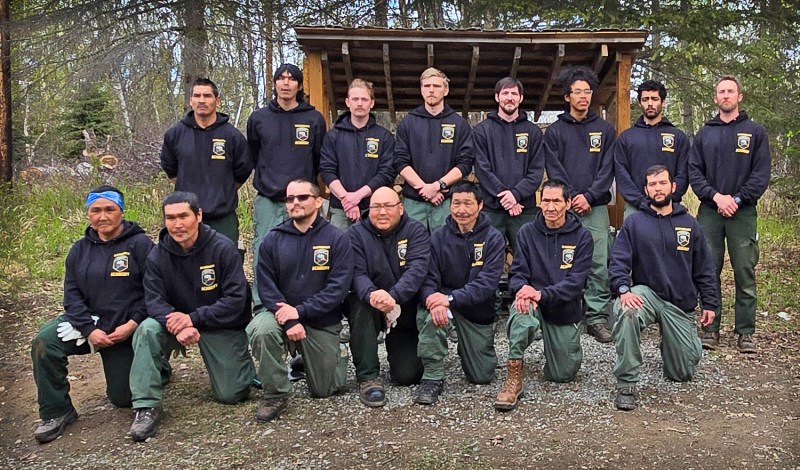

Hailing from remote Alaskan villages including Kwethluk, Chevak, Good News Bay, Hooper Bay, Allakaket, Huslia and others, these cadets bring a rich tapestry of backgrounds and experiences to the forefront, underscoring the imperative of inclusive training initiatives for rural communities. Supported by comprehensive assistance, including air transportation and logistical support, these cadets embark on a transformative journey that encompasses advanced firefighting techniques, leadership development, and incident command system implementation.
Representing entities such as the Mat-Su-based Gannett Glacier Fire Crew, individuals from the Fairbanks Area, Copper River Basin Area, Yukon Fire Crew, and the Scorched Earth Services (SES) contract crews, these cadets bring a wealth of experience and expertise.
“The biggest lesson I learned from this Academy, which is even more valuable than the firefighting skills that I developed, is that every single person that you meet is fighting some sort of internal battle. Treat everyone with respect that they’ve earned for getting to the point where they are standing before you.” Cadet and Gannett Glacier Crew Member Torin Blaker

Left to Right bottom row: Michael Bergman, Dale Boyscout, Mary David, Dylan McNaughton, Awesome Ulroan, Jacob Price, Christopher Fisher, William Kelila, Kristoffer Kerr, Kevin Flynn, Patrick Spein, Preston Kvasnikoff, Ian Green, Eddie Bell Jr., Allen Ulroan
Back row left to right: Brent Bensen, Elizabeth Guess, Jacob MacNeil, Matt Jones, John Rivers, William Knight, Charles Chimeralrea, Guy Atcherian, Patrick Matchian, Damon Huntington, Dan Glass, Eric Beasley, Torin Blaker, Ben Engelhardt, Michael Pifer, Alden Boyscout, Tine Epchook, Levi Williams, Kale Casey, Daniel Skriloff, Christopher Hanson
Collaborating across agencies, the Intermediate Academy boasted a robust team of nine instructors, blending expertise from Alaska, the Kansas Forest Service, and Colorado’s Emergency Response Agencies. Their collective efforts not only enrich the training curriculum but also pave the way for innovative strategies and best practices in wildfire management. From the Incident Commander, Ben Engelhardt, to the Academy’s Operations Chief, Matt Jones, each instructor brings a wealth of experience and dedication to the table, ensuring a holistic approach to firefighter safety and risk management.
“The fact of the matter is, there is a very small percentage of the general population that want to, or can operate in our ‘office’. These cadets are the future and without the them, our ability to protect our natural resources and communities will be [greatly diminished].” – Matt Jones during Intermediate Graduation
As they prepare to embark on their professional journeys, these cadets epitomize the dedication and resolve required in the realm of wildfire management. Their commitment to protecting our natural landscapes and communities underscores their significance as future stewards of Alaska’s wildfire resilience. As these cadets step into the next phase of their careers, armed with newfound knowledge and skills, they stand ready to confront the challenges of Alaska’s wildfire season with confidence and resolve.
We recommend that you follow Alaska’s Hazard Fuels Program Story Map for the scope and scale of fuel break and fuel reduction programs occurring across the state.
“Division of Forestry’s hazardous fuels reduction program has expanded in the past several years, receiving substantial funding from federal and state sources to create fuel breaks and defensible space around our communities. Alaskan fuel breaks have proven their effectiveness in several wildland fires, saving millions of dollars in firefighting costs and homes saved.” – State of Alaska Hazards Fuel Program
As a reminder, burn permits are required from April 1 through August 31. You can pick up a burn permit online at https://dnr.alaska.gov/burn or pick them up at your local forestry office and at many local fire departments.
Read more about protection areas, fire management plans and wildfire in Alaska here: http://forestry.alaska.gov/fire/fireplans
Categories: AK Fire Info, Alaska DNR - Division of Forestry (DOF), recruitment, Training
 Alaska Wildland Fire Information