
To see the entire Video on Facebook, please click on the photo or the link below.

Grapefruit Complex Update, July 4 ,2024
Alaska Incident Management Team 3
Incident Commander- Peter Butteri
Location: 40 Miles north of Fairbanks
Complex Acres: 87,434
Personnel: 290
Containment: 0%
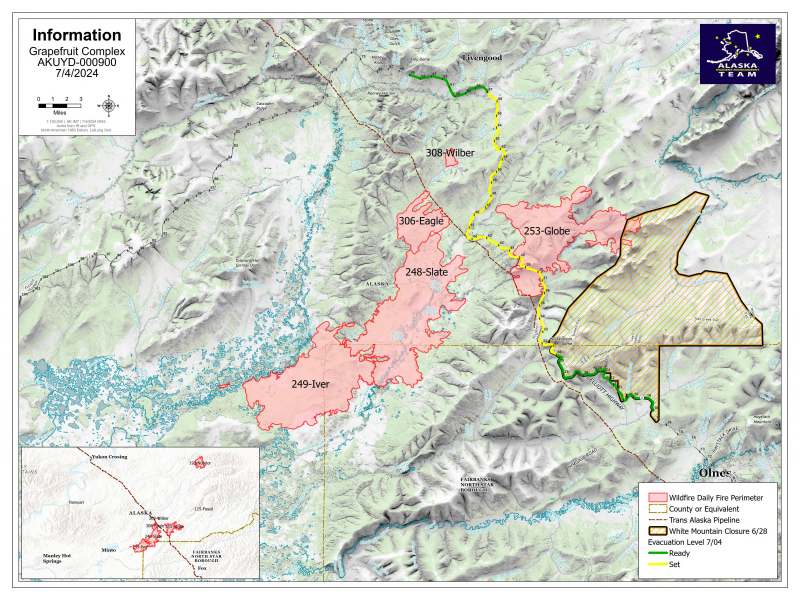
Wind gusts led to an increase in fire acreage Wednesday. Firefighters assessed the Eagle and Wilber fires and determined that while Eagle Fire (#306) impacted the Trans-Alaska Pipeline, it was not damaged. Firefighters also assisted with a new fire south of the Grapefruit Complex near Olnes Pond north of Fairbanks and continued installing protection measures on structures to milepost 57 Elliott Highway.
Southwest wind gusts were 25-35 mph as predicted, with minimal amounts of rain. Thursday and into the weekend, a Siberian weather front is expected to bring significant rain, with 0.5 to 0.75 inches forecast over most of the fire in the next 24 hours. Southwest winds will be strong Thursday, but less intense than Wednesday, with gusts up to 30 mph.
Evacuations remain along the Elliott Highway corridor. As of 11:00 a.m. the State Operation Emergency Operation Center and Alaska State Troopers have decided to reduce the evacuation levels that were recommended by Fire Managers due to the change of weather and fire behavior. The new levels are:
All “Go” (red) evacuations have been reduced
“Set” (Yellow) MM 30 – 57
“Ready” (Green) MM 18-30 and 57-65
Firefighters will continue work to protect property and structures in the area as fires move toward the north and east. While firefighter and public safety remain the highest priority, the focus is on protecting the Elliott Highway, Trans-Alaska Pipeline, Native allotments, public and private structures.
The Globe Fire (#253), estimated at 19,055 acres, continues to spread primarily in an easterly direction and further into the White Mountains National Recreational Area. It also poses threats to sites along the corridor. The Elliott Highway has active fires to the east and west of mileposts 30-50 and is the primary focus for protection.
The Iver Fire (#249), estimated at 49,012 acres remains very active. Predicted southwest winds could impact the highway corridor despite moderate humidity.
Smoke: While air quality in the fire area has improved with the rain, smoke is still present on the highway. Please exercise caution and patience, turn on your headlights to help ensure the safety of firefighters and flaggers working in the area.
The complex also includes:
- The Eagle Fire (#306) is estimated at 5,059 acres. This lightning-caused fire has been burning since June 28. Firefighters remain in place to continue structure protection on the surrounding infrastructure.
- The Wilber Fire (#308) is estimated at 432 acres and was reported at about June 29. It is expected to grow to the north and east of the Elliott Highway and is likely to impact the Alyeska Pipeline and the Elliott and Dalton highways. Structure protection is underway on clusters of cabins and homes along the highway corridor. Crews are preparing incase the fire reaches this group of structures. The fire is about 2.5 miles west of mile 51 Elliott Highway.
- The Noodor Fire (#192) is estimated at 13,868 acres. This lightning-caused fire is burning on BLM-managed land since June 20. This fire is being monitored via aircraft. Fire managers may send resources if fire threatens sites identified for protection if they can safely do so and there are enough resources available.
- The Fossil Fire (#115) is estimated at 8 acres and exhibiting minimal fire activity or smoke but will still be grouped into the complex. It is in the White Mountains National Recreation Area. This fire is being monitored by aerial resources.
Evacuation: Evacuation levels were increased on Tuesday (July 2). The current levels are represented as:
All Go (Red) evacuations have been reduced.
Set (Yellow) MM 30 – 57
Ready (Green) MM 18-30 and 57-65
The Incident Management Team will evaluate the evacuation levels daily with the state emergency operations center and Alaska State Troopers, based on weather and fire conditions.
Road access: The section of the Elliott Highway near the Globe Fire is open. Expect significant delays between mileposts 25-65 if fire activity increases. Plan accordingly by ensuring that you have food, water, and other necessities if traveling through this area. Expect increased fire traffic around milepost 28. Alaska Department of Transportation & Public Facilities contracted workers and a pilot car are helping keep the flow of traffic open. Check https://511.alaska.gov/ for road updates.
Temporary Flight Restriction: A TFR is in place during the day to provide a safe environment for firefighting aircraft.
Closures: The Bureau of Land Management (BLM) Eastern Interior Field Office closed the western portion of the White Mountains National Recreation Area surrounding the Wickersham Dome Trailhead at mile 28 Elliott Highway. The closure is in effect until Sept. 1, unless the BLM determines the area is safe for public use at an earlier time.
Fire Information Public Phone: 907-615-6793.
Inciweb: tinyurl.com/grapefruitcomplexfireinciweb
Facebook: www.facebook.com/BLMAFS
Twitter: twitter.com/BLM_AFS
Link Tree: https://linktr.ee/grapefruitcomplexdate
-BLM-
Bureau of Land Management, Alaska Fire Service, P.O. Box 35005, 1541 Gaffney Road, Fort Wainwright, AK 99703
Need public domain imagery to complement news coverage of the BLM Alaska Fire Service in Alaska?
Visit our Flickr channel! Learn more at www.blm.gov/AlaskaFireService, and on Facebook and Twitter.
The Bureau of Land Management Alaska Fire Service (AFS) located at Fort Wainwright, Alaska, provides wildland fire suppression services for over 240 million acres of Department of the Interior and Native Corporation Lands in Alaska. In addition, AFS has other statewide responsibilities that include: interpretation of fire management policy; oversight of the BLM Alaska Aviation program; fuels management projects; and operating and maintaining advanced communication and computer systems such as the Alaska Lightning Detection System. AFS also maintains a National Incident Support Cache with a $18.1 million inventory. The Alaska Fire Service provides wildland fire suppression services for America’s “Last Frontier” on an interagency basis with the State of Alaska Department of Natural Resources, USDA Forest Service, National Park Service, Bureau of Indian Affairs, U.S. Fish and Wildlife Service, and the U.S. Military in Alaska.
Categories: Active Wildland Fire, AK Fire Info, BLM Alaska Fire Service
 Alaska Wildland Fire Information