Small amount of smoke visible on McDonald, Grapefruit fires Saturday
As expected with the forecasted hot, dry weather, fire activity increased on several large fires in Interior Alaska on Saturday. Despite several days of rain earlier this month, it wasn’t enough to fully extinguish large fires like the McDonald Fire (#119) and the Grapefruit Complex (#900). Warm, dry conditions have revived these fires a little as they consume pockets of unburned vegetation within their perimeters. The recent fire activity is minor and will likely be short-lived as a significant weather change is anticipated on Wednesday, with cooler, wetter conditions moving into mainland Alaska from the southwest. This should subdue the fires again.
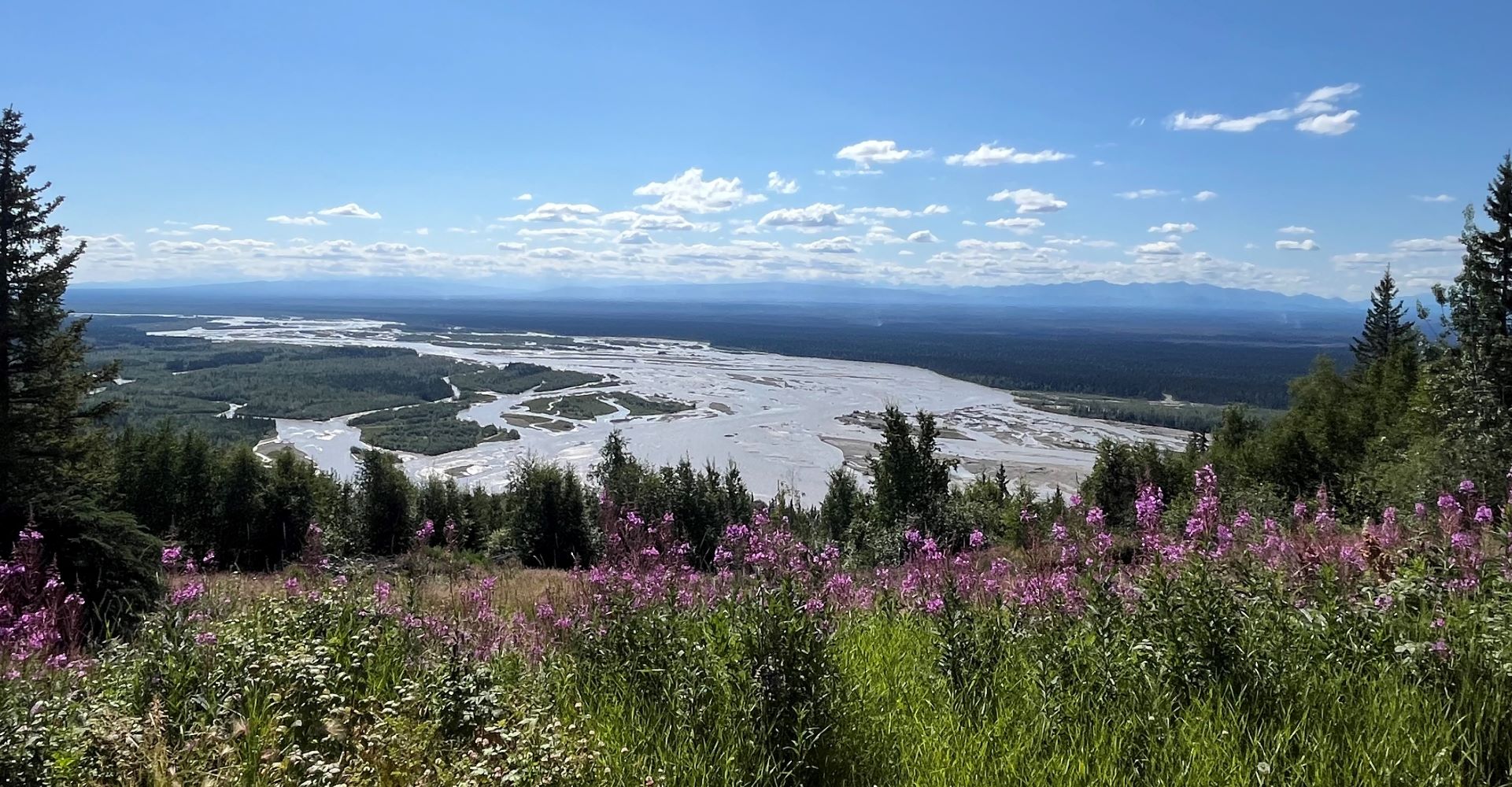
Expecting the uptick in fire behavior with 80-degree weekend weather, firefighters were left in place, and in the case of the McDonald Fire, an additional firefighter was posted on a lookout during this weekend’s dry spell. This lookout reported minor smoke activity on the south end but none on the northern side, where the fire had burned into tundra and a previously burned area from 2020. The McDonald Fire, still west of the Tanana River, merged with the Meridian and Clear fires, burning an estimated 175,638 acres.
The BLM Alaska Fire Service Chena Hotshots and three additional firefighters are working around a cluster of cabins along 5 Mile Creek near the McDonald Fire, mopping up hot spots and removing unnecessary equipment. With no fire growth in recent days, the Chena Hotshots will complete their work on Saturday and demobilize on Sunday, leaving three highly skilled firefighters at the cabin sites, and the lookout for the remainder of the dry spell.
A few firefighters remain on the Grapefruit Complex, finishing mop-up operations while excavators repair land disturbed during the construction of fire breaks around Native allotments. This complex includes six fires, such as the Globe Fire (#253), which crossed the Elliott Highway between mileposts 37-40, and the Eagle, Slate, and Iver fires south of the highway near the Tolovana River.
Approximately 602,000 acres have burned in 340 fires this year. There are still 145 active fires as of Saturday.
-BLM-
Bureau of Land Management, Alaska Fire Service, P.O. Box 35005, 1541 Gaffney Road, Fort Wainwright, AK 99703
Need public domain imagery to complement news coverage of the BLM Alaska Fire Service in Alaska?
Visit our Flickr channel! Learn more at www.blm.gov/AlaskaFireService, and on Facebook and Twitter.
The Bureau of Land Management Alaska Fire Service (AFS) located at Fort Wainwright, Alaska, provides wildland fire suppression services for over 240 million acres of Department of the Interior and Native Corporation Lands in Alaska. In addition, AFS has other statewide responsibilities that include: interpretation of fire management policy; oversight of the BLM Alaska Aviation program; fuels management projects; and operating and maintaining advanced communication and computer systems such as the Alaska Lightning Detection System. AFS also maintains a National Incident Support Cache with a $18.1 million inventory. The Alaska Fire Service provides wildland fire suppression services for America’s “Last Frontier” on an interagency basis with the State of Alaska Department of Natural Resources, USDA Forest Service, National Park Service, Bureau of Indian Affairs, U.S. Fish and Wildlife Service, and the U.S. Military in Alaska.
Categories: Active Wildland Fire, AK Fire Info
 Alaska Wildland Fire Information