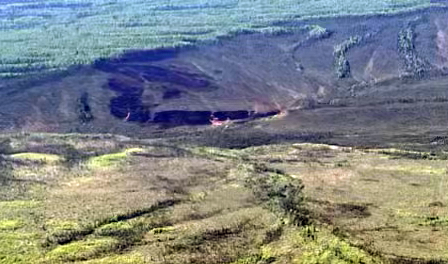
After a day of hard work Monday, firefighters gained the upper hand on five new lightning-caused fires that ignited across BLM Alaska Fire Service protection areas stretching across northern Alaska. Firefighters expect to complete suppression efforts on these wildfires in the coming days.
Today, the BLM AFS Midnight Sun Hotshots and an Alaska Division of Forestry & Fire Protection engine are en route to relieve six of the eight smokejumpers assigned to the Bridge Fire (#141), located about 2 miles east of Mile 52 on the Elliott Highway. This allows the smokejumpers to return to the rotation of available personnel ready to respond to new fires in Alaska – which is highly likely given the warmer weather and forecasted lightning across many parts of the state. Four smokejumpers were also deployed to two smaller fires nearby – the Tatalina Fire (#148) and Trifecta Fire (#149). All three were ignited by lightning.
A thunderstorm that moved through the area Monday evening rapidly increased fire activity on the Bridge Fire before dropping heavy rain that helped moderate fire behavior. The Bridge Fire is estimated at 28 acres, while the two nearby fires are each less than half an acre.
Suppression efforts on the Bridge Fire were supported by two single-engine water scoopers, an air tanker dropping retardant, a helicopter, and an air attack aircraft coordinating aerial operations as the fire burned through black spruce.
Elsewhere, eight smokejumpers successfully halted the forward progress of the Bachelor Fire (#135) north of the Steese Highway Monday afternoon. Steady winds pushed the fire upslope through tundra grass and into trees, but the coordinated effort – including single-engine water scoopers and two helicopters – slowed the spread. The fire is estimated at 50 acres. Today, firefighters are extinguishing remaining hot spots.
Smokejumpers reported that while black spruce trees were prone to torching, the moss and lichen ground layer was not holding significant heat – an encouraging sign as summer heat intensifies.
Meanwhile, six smokejumpers have contained the Canyon Fire (#139) north of Kiana. They are now focused on extinguishing any remaining hot spots to ensure full suppression. The fire remains estimated at 2 acres.
Nearly 6,000 lightning strikes were recorded across Alaska on Monday, igniting several new wildfires. Most are located in remote areas and will be monitored as warm, dry weather continues. More lightning is forecast across a wide swath of Alaska today, from north of the Alaska Range to the far north.
Red Flag Warnings are in effect for a large portion of the state, from Lime Village in Southwest Alaska to the Yukon Flats, for hot, dry, and windy weather – and, in some areas of Western Alaska, lightning. Some of the Red Flag Warnings for lightning expire today, while the one for the Kuskokwim Valley is in effect from 2 p.m. until midnight Tuesday.
As of noon Tuesday, 136 fires have burned an estimated 4,330 acres statewide – 28 of them igniting within the past two days. That number is expected to grow with additional lightning in the forecast.
To keep pace with the uptick in fire activity, fire managers have requested additional resources, including 32 more smokejumpers, additional single- and multi-engine water scoopers, and more air attack aircraft and aerial supervision personnel.
Detection flights are also underway to identify potential holdover fires – smoldering hot spots that may reignite as conditions grow warmer, drier, and windier.
For more information, contact BLM AFS Public Affairs Specialist Beth Ipsen at (907) 356-5510 or eipsen@blm.gov.
-BLM-
Bureau of Land Management, Alaska Fire Service, P.O. Box 35005 1541 Gaffney Road, Fort Wainwright, Ak 99703
Need public domain imagery to complement news coverage of the BLM Alaska Fire Service in Alaska? Visit our Flickr channel!
Learn more at www.blm.gov/AlaskaFireService, and on Facebook and Twitter.
The Bureau of Land Management Alaska Fire Service (AFS) located at Fort Wainwright, Alaska, provides wildland fire suppression services for over 240 million acres of Department of the Interior and Native Corporation Lands in Alaska. In addition, AFS has other statewide responsibilities that include: interpretation of fire management policy; oversight of the BLM Alaska Aviation program; fuels management projects; and operating and maintaining advanced communication and computer systems such as the Alaska Lightning Detection System. AFS also maintains a National Incident Support Cache. The Alaska Fire Service provides wildland fire suppression services for America’s “Last Frontier” on an interagency basis with the State of Alaska Department of Natural Resources, USDA Forest Service, National Park Service, Bureau of Indian Affairs, U.S. Fish and Wildlife Service, and the U.S. Military in Alaska.
Categories: Active Wildland Fire, AK Fire Info, BLM Alaska Fire Service
 Alaska Wildland Fire Information