The area around the Lush Fire (#199) experienced hot, dry, windy weather Saturday. The conditions helped the fire spread nearly 3 miles northeast. Firefighters reported crown fires, group torching, and spotting during the day as the fire crossed Squaw Creek and neared Lush Lake.
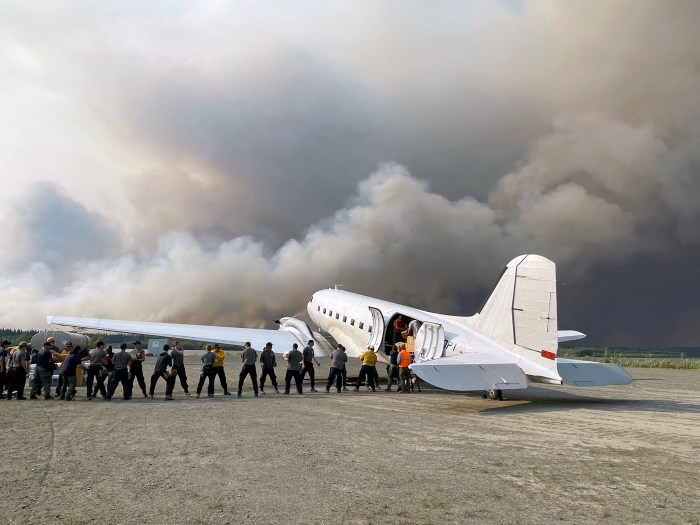
Firefighters continued work Saturday to create defensible space around structures and Alaska Native allotments on the north side of the Yukon River. They also set up hoses, pumps and sprinklers around structures to help protect them.
Smokejumpers, the BLM Midnight Sun Hotshots, and the North Star Fire Crew were joined by a pair of Type 2 BLM Contract Crews – the Huslia-based SES Fire K-River Crew #1 and the Mooseheart Crew based out of other nearby villages.
Ninety-five people are assigned to the fire, which was sparked by lightning on June 18. The fire is still on the north side of the Yukon River across from the community of Rampart.
There will be a community meeting in Rampart at noon today, where fire managers will update residents about the efforts to protect allotments and structures. The location is to be determined.
Elsewhere in the Tanana Zone, five smokejumpers are working to put out the Bootlegger Fire (#236), which is on the north side of the Yukon River east of Ruby.
The fire was started by lightning on Thursday. It is about 3 acres. Initial attack consisted of aircraft dropping water on the fire to slow its spread because other firefighting resources were unavailable at the time. Smokejumpers were reassigned to the fire Saturday and have it 30 % contained. They were aided by a helicopter, which dropped water on the fire throughout the day.
Fire managers are monitoring other fires that are burning south of Rampart in Limited Management Option Areas, which allow wildfires to fulfill their natural ecological role unless they pose a threat to life or property. If a fire endangers values at risk – such as cabins, fish camps or allotments – firefighters may be mobilized to protect those values without fully suppressing the fire. This strategy prioritizes firefighter safety and the protection of critical sites while ensuring resources remain available for higher-priority wildfires elsewhere in densely populated communities. Others fires are burning in areas that would normally get a response if more firefighters were available.
With firefighting resources stretched thin, local, federal and state agencies are working together to prioritize responses where firefighter and public safety are most at risk and are coordinating closely to share resources. In addition, the Alaska Preparedness Level was elevated today to Level 4 (on a scale of 1 to 5).
On Saturday, 28 new fires were reported following a week of widespread thunderstorms and persistent hot, dry conditions. As of this morning, 278 wildfires have burned approximately 101,000 acres with many evacuations in various communities around the Interior. Twenty-one of those fires are currently staffed. Two jets with four firefighting crews each are arriving in Fairbanks in the next two days. More crews are being requested to join the effort in Alaska.
-BLM-
Bureau of Land Management, Alaska Fire Service, P.O. Box 35005 1541 Gaffney Road, Fort Wainwright, Ak 99703
Need public domain imagery to complement news coverage of the BLM Alaska Fire Service in Alaska? Visit our Flickr channel!
Learn more at www.blm.gov/AlaskaFireService, and on Facebook and Twitter.
The Bureau of Land Management Alaska Fire Service (AFS) located at Fort Wainwright, Alaska, provides wildland fire suppression services for over 240 million acres of Department of the Interior and Native Corporation Lands in Alaska. In addition, AFS has other statewide responsibilities that include: interpretation of fire management policy; oversight of the BLM Alaska Aviation program; fuels management projects; and operating and maintaining advanced communication and computer systems such as the Alaska Lightning Detection System. AFS also maintains a National Incident Support Cache. The Alaska Fire Service provides wildland fire suppression services for America’s “Last Frontier” on an interagency basis with the State of Alaska Department of Natural Resources, USDA Forest Service, National Park Service, Bureau of Indian Affairs, U.S. Fish and Wildlife Service, and the U.S. Military in Alaska.
Categories: Active Wildland Fire, AK Fire Info, BLM Alaska Fire Service
 Alaska Wildland Fire Information