Today, windy conditions out of the north will continue to increase wildfire acreage in the Galena Zone – an area the size of Montana covering Western Alaska north of the Yukon River. There are 60 active wildfires in the zone with five new fires reported on Tuesday evening. Firefighters anticipate more ignitions as holdover heat from recent lightning strikes emerge.
Weekend weather will trend toward hotter and drier conditions, increasing the probability of new holdover fires. Some fires, called holdover or sleeper fires, smolder below the surface until temperatures rise, vegetation dries, and wind breathes life into the smoldering hotspots.
The Shiliak Fire (#374) is at 70% contained and staffed by 12 smokejumpers conducting heavy mop up as heat is settling deep into the duff ground layers and dry fuels in spruce. The fire is burning within 2 miles of Alaska Native allotments. Smokejumpers will continue mop up operations and anticipate completion by early next week.
The Jade Fire (#407), located about 17 miles northwest of Ambler and 1.5 miles north of the Kobuk River at river mile 61, was contained and controlled at 4 acres on Tuesday. Firefighters will continue to monitor the fire for potential threats.
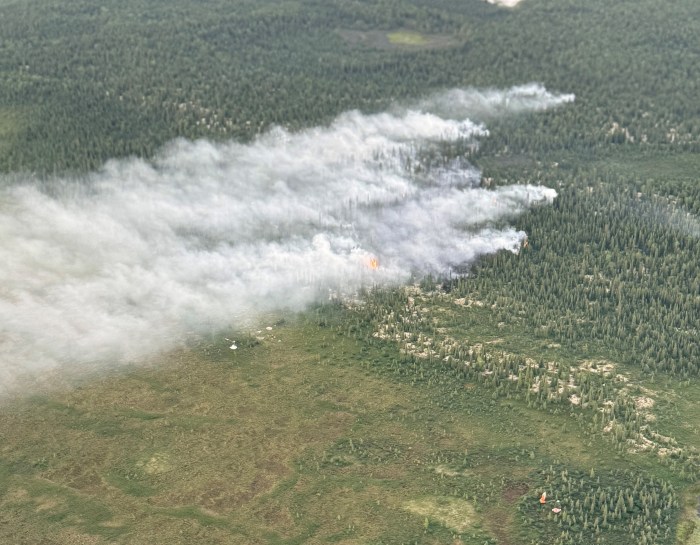
The Karet Fire (#408) is being managed by 10 smokejumpers using a contain and control strategy. The crew reached 100% containment by the end of shift on Tuesday. A system of hoses was installed around the Karet Fire and a small spot fire. This wildfire is burning in tundra and spruce south of the Kobuk River in the same area as the Jade Fire. Mop-up operations are looking good, and the crew estimates demobilization by the end of the week.
The Hunt (#409), Kaliguricheark (#410), and Kobuk (#411) fires are burning in Kobuk Valley National Park about 7 miles north of the Kobuk River at river mile 37 and 1.5 miles east of Kaliguricheark River at river mile 11. All three fires are burning in tundra and a mixture of spruce trees. The Hunt Fire (#409) showed no growth on Tuesday, but strong sustained northerly winds pushed moderate fire growth on the Kobuk (#411) and the Kaliguricheark (#410), grew to around 3000 acres. Smokejumpers will continue to monitor fire activity to assess protection point needs until resources are available to prep nearby sites identified as of value.
Due to sustained strong winds smokejumpers were unable to catch the Nuna Fire (#420), which had a significant increase in activity on Tuesday. The smokejumpers were placed on Alaska Native allotment protection along the Kobuk River and will utilize boat transport to ease assessment and triage of assets along the river.
Five new starts were reported on Tuesday:
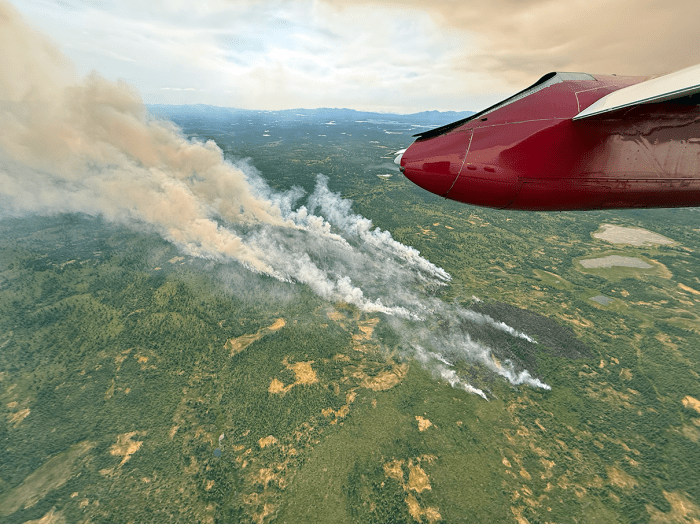
Twelve smokejumpers continue efforts to contain the 150-acre Salmon Fire (#423) and multiple spot fires coming from that fire. The Salmon Fire is south of the Kobuk River and southwest of the Kaliguricheark (#410) Fire. The Tututsuk (#424) Fire located due west of the Kaliguricheark (#410). The firewas at 120 acres on Tuesday evening but grew to 600 acres overnight .Firefighters will monitor for potential threats.
Egaupack (#426) and Kerchurak (#427) Fires, burning south of the Karet (#408) Fire, will be monitored for potential threat.
Sustained strong winds, warmer temperatures and a lack of precipitation will continue to further dry fuels in Western Alaska. Fire activity is expected to increase over the weekend and into next week. Firefighters will continue to look for new starts and monitor all existing wildfires for changing conditions and potential threats.
For more information about Galena Zone fires contact the Alaska Interagency Joint Information Center at Phone: 907-356-5511, email akacc.information@firenet.gov.

-BLM-
Bureau of Land Management, Alaska Fire Service, P.O. Box 35005 1541 Gaffney Road, Fort Wainwright, Ak 99703
Need public domain imagery to complement news coverage of the BLM Alaska Fire Service in Alaska? Visit our Flickr channel!
Learn more at http://www.blm.gov/AlaskaFireService, and on Facebook.
The Bureau of Land Management Alaska Fire Service (AFS) located at Fort Wainwright, Alaska, provides wildland fire suppression services for over 240 million acres of Department of the Interior and Native Corporation Lands in Alaska. In addition, AFS has other statewide responsibilities that include: interpretation of fire management policy; oversight of the BLM Alaska Aviation program; fuels management projects; and operating and maintaining advanced communication and computer systems such as the Alaska Lightning Detection System. AFS also maintains a National Incident Support Cache. The Alaska Fire Service provides wildland fire suppression services for America’s “Last Frontier” on an interagency basis with the State of Alaska Department of Natural Resources, USDA Forest Service, National Park Service, Bureau of Indian Affairs, U.S. Fish and Wildlife Service, and the U.S. Military in Alaska
Categories: Active Wildland Fire, AK Fire Info, BLM Alaska Fire Service
 Alaska Wildland Fire Information