As a result of new thermal imaging and improved mapping, the Ptarmigan Complex total fire acreage increased to 49,508 acres. The acreage for the largest fire, the Turtle Fire (#242) is 34,903. The Ikheenjik Fire (#243) is being included as part of the Turtle Fire for management and acreage. There was minimal fire activity present yesterday across the complex, with the observed fire behavior consisting of flanking, creeping, and smoldering. The warming and drying trend for the weekend may still lead to an increase in fire activity and smoke.
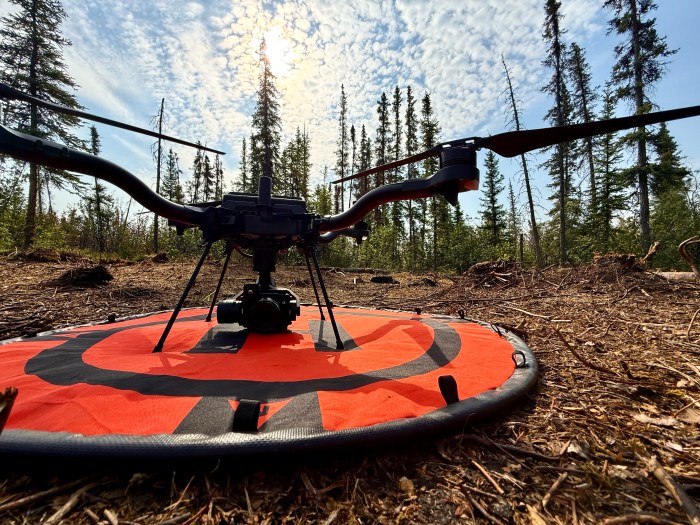
A drone equipped with thermal imaging capability, referred to as a UAS (uncrewed aerial system) module, continues to be assigned to the Ptarmigan Complex and will be operating in the area. Members of the public should be aware that a Temporary Flight Restriction (TFR) will be in place for areas where the UAS module is working each day. Please check FAA.gov for updated TFR and NOTAM notices in the area. Remember, if you fly, we can’t!
Turtle Fire (#243) – The Tatanka Hotshots, Smith River Hotshots, and the Alaska Range Module continue to utilize direct tactics on the north end of the fire, and are working towards each other’s lines. On the south and east portions of Turtle, fire behavior continues to be moderate, and minimal activity was observed. The Turtle Fire was started by lightning. It was reported on June 19 and is burning about 10 miles east of Central, AK and 12 miles south of Circle, AK.
Buckley Bar (#264)— On July 12 Siskiyou Rappelers engaged in point protection and created defensible space around two historic cabins located on the South Fork and Yukon Fork of Birch Creek. A helispot was approved in the area of each cabin for access and egress purposes. Today cabin preparation will be completed on the Buckley Bar cabin. The fire lies about 17 miles to the southwest of Central. It was discovered on June 20 and was caused by lightning.
Birch Fire (#256) – Smoke was observed on the northeast corner, and firefighters took direct action along the edge yesterday to slow the spread. The Birch Fire remains on the east side of Birch Creek. A reconnaissance flight on the Birch fire will be conducted today to determine what, if any, additional action is needed. The fire was discovered on June 20, caused by lightning, and is about 4 miles northwest of Circle, AK.

Alligator Fire (#265) – The assigned drone module (UAS) flew the fire yesterday and found only one heat signature well within the fires perimeter on the north east corner. The fire was discovered on June 20, started by lightning, and is about 3 miles north of Central, AK.
Deadwood Fire (#214) –The fire remains in monitor status. The Deadwood Fire was started by lightning, discovered on June 20, and is in Central, AK.
A Level 1 “Ready” Alert remains in effect for the community of Central, the Steese Highway from Milepost 123 to Milepost 151, Circle Hot Springs Road and Circle Hot Springs, and Deadwood Creek Road. Drivers should expect traffic delays on the Steese Highway, Circle Hot Springs Road, and Deadwood Creek Road due to firefighting operations. A Level 1 “Ready” alert means: begin preparing for a potential evacuation; make plans for family members with special needs, pets, or livestock; gather essential items such as prescriptions, important documents, and valuables; and stay alert and watch for updates from local authorities.
NOTAM #: 07/118 is in place for the Central Airport (CEM): Increased air traffic 5,000 ft MSL and below within a 20 nautical mile radius of the Central Airport (CEM) due to firefighting aviation operations
-BLM-
Bureau of Land Management, Alaska Fire Service
P.O. Box 35005 1541 Gaffney Road, Fort Wainwright, AK 99703
Need public domain imagery to complement news coverage of the BLM Alaska Fire Service in Alaska? Visit our Flickr channel!
Learn more at http://www.blm.gov/AlaskaFireService, and on Facebook.
The Bureau of Land Management Alaska Fire Service (AFS) located at Fort Wainwright, Alaska, provides wildland fire suppression services for over 240 million acres of Department of the Interior and Native Corporation Lands in Alaska. In addition, AFS has other statewide responsibilities that include: interpretation of fire management policy; oversight of the BLM Alaska Aviation program; fuels management projects; and operating and maintaining advanced communication and computer systems such as the Alaska Lightning Detection System. AFS also maintains a National Incident Support Cache. The Alaska Fire Service provides wildland fire suppression services for America’s “Last Frontier” on an interagency basis with the State of Alaska Department of Natural Resources, USDA Forest Service, National Park Service, Bureau of Indian Affairs, U.S. Fish and Wildlife Service, and the U.S. Military in Alaska.
Categories: Active Wildland Fire, AK Fire Info, BLM Alaska Fire Service
 Alaska Wildland Fire Information