Unless there are significant changes in fire activity within BLM AFS’s 191.5-million-acre protection area, this will be the final update of the 2025 fire season.
After several days of rain across much of the state, a warm and dry pattern is returning for the weekend — with the Yukon Flats and Eastern Interior remaining the most active areas due to persistent dry conditions. Despite the change in weather, the shorter days, strong overnight humidity recovery, and past firefighting efforts are expected to help keep fire activity in check.
The number of staffed fires in the BLM Alaska Fire Service protection area continues to decline. Most fires are now in monitor status. Some are being allowed to fulfill their natural ecological role, while firefighters focus on protecting nearby sites of value, transporting unneeded equipment back to the BLM AFS Cache in Fairbanks, or completing administrative tasks.
Below is an update on key fires currently being managed by BLM AFS.
Ninetyeight Fire (#218)
The Fairbanks North Star Borough today lifted the evacuation notice for the Lower, Middle, and Upper Salcha River zones associated with the fire. Fire activity had already moderated, and recent significant rainfall further reduced any remaining heat. Firefighters, including the Shasta-Trinity Helitack Crew from California, pulled all equipment and demobilized on Thursday.
The lightning-caused fire has been burning north of the Salcha River southeast of Fairbanks since June 19. It merged with the Brigadier Fire burning in the Yukon Training Area east of Eielson Air Force Base to burn a combined estimated 16,534 acres.
BLM AFS Military Zone firefighters will continue to patrol Brigadier Road in the Yukon Training Area, which provides a good vantage point of the area, and are prepared to re-engage in structure protection if needed.
Read all the Ninetyeight Fire updates here. To find your property check the Fairbanks North Star Borough evacuation map here: bit.ly/3GfwZyt.
Christian Fire (#255)
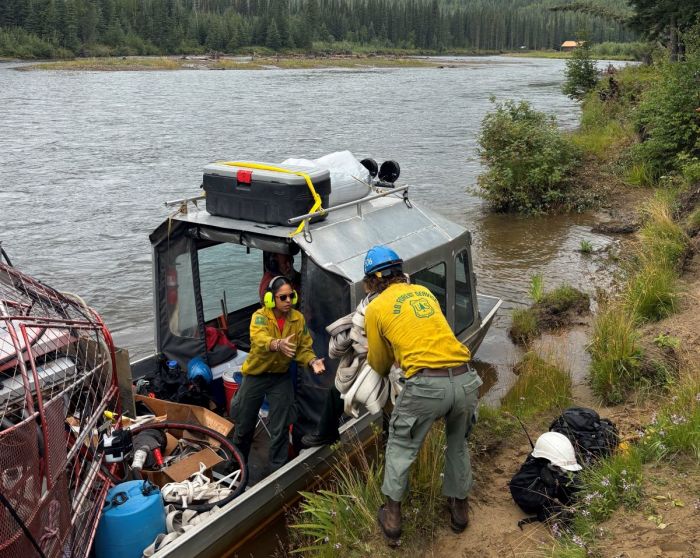
Twelve smokejumpers assigned to the fire are using a boat to travel between an Alaska Native allotment and nearby cabins along the Sheenjek River. During their patrols, they recently identified another group of cabins about six miles from the fire’s perimeter, which are not currently threatened. The crew will remain on the fire through the weekend to ensure the allotment and nearby cabin remain protected as warm, dry weather continues.
This 52,468-acre fire is burning in a limited management option area within the Yukon Flats National Wildlife Refuge. In these areas, wildfires are generally allowed to play their natural ecological role unless they threaten people or property. When values are at risk, firefighters may take targeted action to protect them without stopping the overall fire spread. This strategy emphasizes firefighter safety, protection of values, and minimizing impact to the landscape.
Ptarmigan Complex
Only a handful of people remain on this complex of eight fires burning near Central and Circle. Once a dozer line used to help suppress the 147-acre Deadwood Fire (#214) is repaired, all remaining personnel will demobilize. This fire was called out on July 21. All fires are in otherwise in monitor status.
Read all the Ptarmigan Complex updates here.
Obrien Fire (#172)
Due to reduced fire activity and successful suppression efforts, starting today, the BLM Eastern Interior Field Office opened access in the White Mountain National Recreational Area to Lee’s and Moose Creek cabins, and Wickersham Dome. Although reduced in size, a fire closure area is still needed for public and firefighter safety due to activity.
This lightning-caused fire was grouped and managed with the nearby Himalaya Road and Aggie Creek Fires until management was returned to the Upper Yukon Zone management last week. It was estimated at 8,125 acres and is being monitored after firefighters had earlier done work to protect four public use cabins.
Find more information about this reduced closure order including a map here.
Lush Fire Update (#199)
On Thursday morning, management of the fire transitioned from a Type 3 to a Type 4 team, reflecting reduced fire activity. Thirty-nine personnel remain assigned to the incident, including the 20-person BLM AFS Chena Hotshots, who are securing a fireline by making sure all remaining hotspots are extinguishing before demobilizing on Sunday. They are the last crew on the fire.
Crews have completed all fireline construction near 21 Alaska Native allotments and multiple structures along the river. Two helicopters remain assigned to support the fire with supply runs, reconnaissance flights, and bucket work if needed.
The fire, burning north of the Koyukuk River across from Rampart, remains 26,544 acres with no growth in recent days. Fire activity has been minimal, with some smoldering and creeping in areas of unburned vegetation. Most of the fire is burning in black spruce and brush.
Read all the Lush Fire updates here.
Roundabout Complex
Twenty-two personnel are assigned to a complex of six fires near Huslia, with all but the 72,875-acre Moldy Fire (#279) in monitor status. Fire behavior remains minimal, with some smoldering and creeping. There has been no change in reported acreage.
The Moldy Fire, discovered on June 20, is burning across the Koyukuk River from Huslia and is now 80% contained. The BLM AFS Midnight Sun Hotshots are completing mop-up operations along the fire’s edge and removing equipment today. They will return to their home base in Fairbanks once finished. All personnel are expected to be out of Huslia by the end of the day, as management of the fire transitions back to the BLM AFS Galena Zone.
The Billy Hawk (148 acres), Billy Hawk 2 (11 acres), Louie (1 acre), and Richards (577 acres) fires were all fully suppressed. Firefighters also successfully protected nearby sites of value from the 1,915-acre Caribou Fire by allowing the fire to play its natural ecological role where it posed no threat, while concentrating suppression efforts in areas where important values were at risk.
Read all the Roundabout Complex updates here.
Goldrun Complex
There are only seven people assigned to the complex of nine fires burning between Ambler and Kiana in the Northwest Arctic. They relocated to Galena on Thursday where they are wrapping up more administrative tasks. None of the fires have shown growth in several days and were exhibiting only minimal fire activity.
The Onion Fire (#433), discovered on July 9, is located south of the Kobuk River and is estimated at about 1,307 acres. The Mooseheart Crew, a Type 2 contract crew comprising firefighters assembled from Fairbanks, Tanana, and Minto, finished up work of mopping up the fire and removing unneeded equipment, and demobilized on Thursday.
The Nuna Fire (#420), discovered on July 7, is estimated at approximately 15,000 acres and is burning due west of the Jade Mountains, north of the Kobuk River, is being monitored with periodic aerial flights. The 11,858-acre Kaliguricheark Fire (#410), which previously burned through the Kobuk Fire (#411), Hunt Fire (#409), and Tutuksuk Fire (#424), is also in monitor status.
The Jade (#407), Karet (#408), and Salmon (#423) fires are contained and controlled, and are also being monitored.
Read all the Goldrun Complex updates here.
For more information, contact BLM Alaska Fire Service Public Affairs Specialist Beth Ipsen at (907)356-5510 or eipsen@blm.gov.
-BLM-
Need public domain imagery to complement news coverage of the BLM Alaska Fire Service? Visit our Flickr channel!
Learn more at www.blm.gov/AlaskaFireService, and on Facebook, X, and YouTube.
The Bureau of Land Management Alaska Fire Service (AFS) located at Fort Wainwright, Alaska, provides wildland fire suppression services for over 240 million acres of Department of the Interior and Native Corporation Lands in Alaska. In addition, AFS has other statewide responsibilities that include: interpretation of fire management policy; oversight of the BLM Alaska Aviation program; fuels management projects; and operating and maintaining advanced communication and computer systems such as the Alaska Lightning Detection System. AFS also maintains a National Incident Support Cache. The Alaska Fire Service provides wildland fire suppression services for America’s “Last Frontier” on an interagency basis with the State of Alaska Department of Natural Resources, USDA Forest Service, National Park Service, Bureau of Indian Affairs, U.S. Fish and Wildlife Service, and the U.S. Military in Alaska.
Categories: Active Wildland Fire, AK Fire Info, BLM Alaska Fire Service, BLM Eastern Interior Field Office
 Alaska Wildland Fire Information