Take your wildland firefighting skills to the next level and apply by Dec. 2
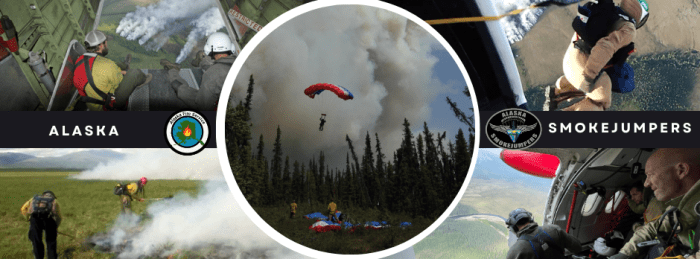
The BLM Alaska Fire Service is looking for hard working, physically fit, intelligent and experienced wildland firefighters interested in becoming Alaska Smokejumpers. If you’re an experienced wildland firefighter looking for a new challenge, fill out this online interest form or apply on USAJobs.gov by the Dec. 2, 2025 deadline.
Click these buttons for job announcements!
The mission of the Alaska Smokejumpers is to provide users with highly qualified, safe, and aggressive wildland firefighters whom quickly and effectively respond to initial attack, extended attack, and point protection missions in Alaska and the Lower 48 states. Utilizing high performance fixed-wing aircraft and specialized parachutes, the Alaska Smokejumpers provide a rapid and long-range response capability for a wide variety of wildland fire missions.
The majority of selected Rookie applicants will be hired as GW-05/06/07Career Seasonals. All Rookies will start as GW-05’s and can transition into a GW-06 and GW-07 when time in grade and qualifications allow. We highly advise any individual interested in jumping to apply to all announcements.
Successful candidates typically have three to five years wildland firefighting experience and can far surpass these fitness standards.
- Run 1.5 miles above the minimum required standard of 10:47 minutes.
- At least six pull-ups.
- At least 30 push-ups.
- Carry a 110-pound pack in 65 minutes or less.
- At least 60 sit-ups within three minutes.
Why are Alaska Smokejumpers different?
Equipped with high-performance aircraft and specialized parachutes, Alaska smokejumpers deliver rapid, long-range response capabilities for diverse wildland fire missions. Think you’ve got what it takes? Discover the requirements and apply today. Click this link for more information. Watch this YouTube video about Alaska Smokejumpers.
Due to its remote nature, Smokejumpers are the primary initial attack force for federally protected lands covering over 192 million acres in Alaska and provide significant assistance to interagency partners in Alaska and the lower 48 states.
In addition to no state income tax, Alaska has a significant locality payment (32.36% in 2025) and a 1.49% cost of living allowance beyond base salary.
BLM AFS has one of two BLM smokejumper bases and is among nine national smokejumper bases. Government housing and meals are available for all Smokejumpers to off-set cost of living during the fire season.
The Alaska Smokejumper paracargo (PC) section is the largest civilian PC program in the world, dropping yearly average of 300,000 lbs. In addition to PC program, the Alaska Smokejumpers have unique firearms and watercraft qualifications for jetboat, Zodiac boat and pack raft.
Watch this YouTube video about the Alaska Smokejumper paracargo program.
Personal attributes required
- Service Oriented: BLM AFS Smokejumper program is a service organization dedicated to performing with excellence every time we are called.
- Self-reliance, cooperation, teamwork: Smokejumping demands both self-reliance when the mission calls for largely independent action, and teamwork. Smokejumpers must be able to cooperate with firefighters and others from a multitude of agencies and backgrounds.
- Adaptability: Smokejumper candidates should realize that change, frequent travel, and uncertainty are part of the job. Smokejumpers must adapt well to rapidly changing environments and situations, prolonged periods of intense fire activity, and periods of no fire activity.
- Attitude: A positive, “can do” attitude is essential.
- Physical Fitness: Smokejumper specific duties demand exemplary physical conditioning. Smokejumpers are required to maintain peak fitness due to the extreme physical demands of the job; all jumpers must be in excellent condition. It is not uncommon to construct fireline for 14 to 16 hours per day on a regular basis. Both strength and endurance are of the utmost importance.
The Alaska Smokejumpers are looking for individuals who are ready to meet challenges head-on and embrace a career filled with purpose and adventure. If you have what it takes to excel in a demanding environment, we urge you to apply to all three announcements. This is more than just a job — it’s a chance to be part of a team that makes a difference every day. Prepare yourself for the journey, and get ready to join a legacy of excellence and service.
Find more information about Alaska Smokejumpers online and about our recruitment here.
🛠️ New this year is the Merit Hiring Plan requirement that requires resumes MUST be limited to 2-pages. If your resume is longer, only the first two pages will be reviewed – which could cost you the job. Need help with the new resume format? Check out the official guidance here: https://help.usajobs.gov/faq/application/documents/resume/page-limit
Contact for more information
Lead rookie Trainer: Nick Biedscheid (907) 370-3744, nbiedscheid@blm.gov.
Editor’s note: The dates of job announcement openings were updated.
Watch this YouTube video of Alaska Smokejumpers at BLM AFS smokejumper base gearing up for a fire jump.
-BLM-
Bureau of Land Management, Alaska Fire Service, P.O. Box 35005 1541 Gaffney Road, Fort Wainwright, Ak 99703
Need public domain imagery to complement news coverage of the BLM Alaska Fire Service in Alaska? Visit our Flickr channel!
Learn more at www.blm.gov/AlaskaFireService, and on Facebook and Twitter.
The Bureau of Land Management Alaska Fire Service (AFS) located at Fort Wainwright, Alaska, provides wildland fire suppression services for over 240 million acres of Department of the Interior and Native Corporation Lands in Alaska. In addition, AFS has other statewide responsibilities that include: interpretation of fire management policy; oversight of the BLM Alaska Aviation program; fuels management projects; and operating and maintaining advanced communication and computer systems such as the Alaska Lightning Detection System. AFS also maintains a National Incident Support Cache. The Alaska Fire Service provides wildland fire suppression services for America’s “Last Frontier” on an interagency basis with the State of Alaska Department of Natural Resources, USDA Forest Service, National Park Service, Bureau of Indian Affairs, U.S. Fish and Wildlife Service, and the U.S. Military in Alaska.
Categories: AK Fire Info, BLM Alaska Fire Service
 Alaska Wildland Fire Information