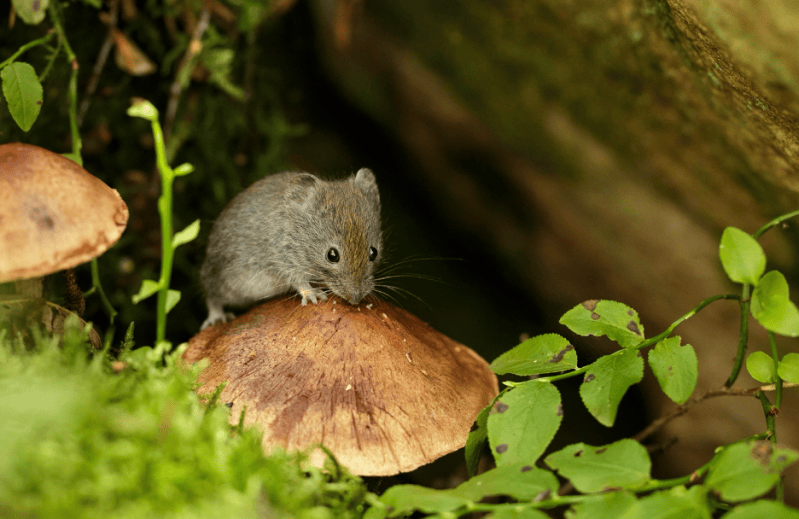
Beneath the soil of a regenerating forest lies an unseen engine driving new growth, and an unlikely partner making it happen.
A strong partnership between the Alaska Division of Forestry & Fire Protection (DFFP) and the Alaska Department of Fish & Game (ADF&G) is highlighting how even the smallest players can have the biggest impact. Joint research is investigating how small mammals act as ecosystem engineers by spreading underground fungal spores that help young trees survive and thrive.
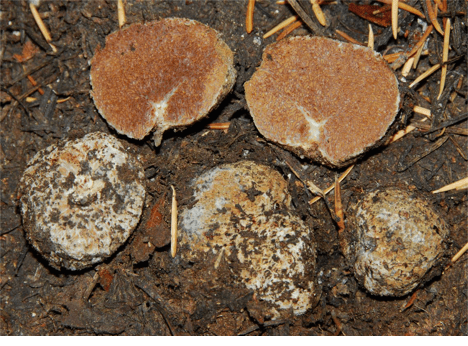
Unlike above-ground mushrooms, whose spores are often dispersed by wind, hypogeous fungi (commonly known as truffles or false truffles) develop entirely underground. Because their spores are enclosed within subterranean fruiting bodies, they rely on animals to dig them up, eat them, and transport their spores to new locations.
Small mammals such as voles and flying squirrels dig up and consume these fungal fruiting bodies, then deposit viable spores across the forest floor in their scat. The spores go on to form more fungi, which form a mutually beneficial relationship with particular plant roots, called mycorrhizae.
Conifers (like white spruce) and hardwood species (like birch and poplar) rely heavily on mycorrhizae. In this symbiotic exchange, plants share the sugars they create through photosynthesis with the fungus, while the fungus extends long filaments deep into the soil, farther than the plant roots can reach, to absorb and provide additional water and nutrients.
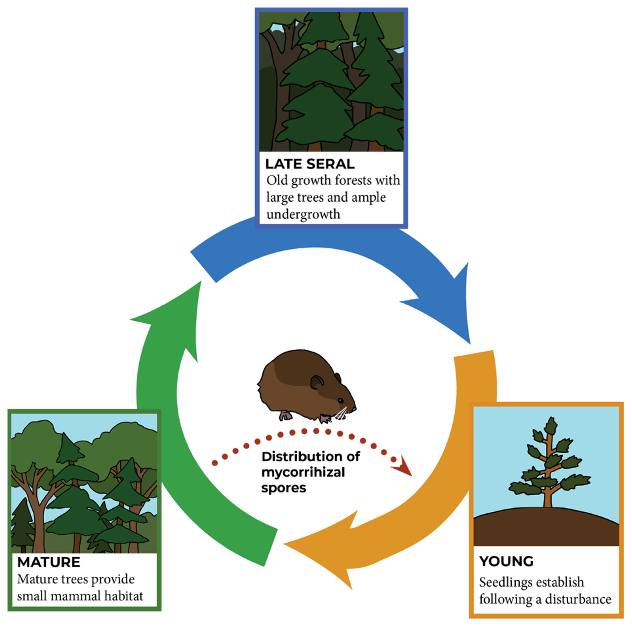
Success of seedling trees in Alaska (and elsewhere across the globe) depends upon this root-based symbiotic association with hypogeous fungi to expand their root reach, absorb water and nutrients, and resist disease. Small mammals across Alaska’s boreal forest consume significant amounts of these fungi, making them important drivers of inoculating soils with fungal spores essential for tree roots. Within the forest succession cycle, small mammals help to “reset the clock,” jumpstarting seedling success in a long-term process that could otherwise take decades (see diagram below).
A Partnership Rooted in Forest Stewardship
DFFP and ADF&G have a long history of collaboration through habitat enhancement projects and implementation of the Forest Resources and Practices Act (FRPA). The seeds of this project were planted during the 2016 FRPA Reforestation Review, a joint effort led by both agencies. While FRPA traditionally focused on fish habitat and forest regeneration, the review created an opportunity to explore how wildlife may influence reforestation outcomes as well.
The idea gained momentum when DFFP State Forester and Director Jeremy Douse encountered research describing the role of small mammals and fungal dispersal in forests of the Lower 48. Curious whether similar relationships existed in Alaska, he approached ADF&G wildlife biologists Julie Hagelin and Tom Paragi and invited them to present the concept at a Society of American Foresters conference.
Hagelin noted that while this type of study had not yet been conducted in Alaska, there was good reason to expect similar ecological relationships existed in the state’s boreal forests. She also helped identify the expertise needed to move the project forward. Soon afterward, DFFP secured funding to begin investigating whether Interior Alaska’s small mammals disperse spores of hypogeous fungi associated with tree species important to reforestation.
Through shared funding and expertise, DFFP and ADF&G have supported field efforts to collect both small mammal specimens and tree root samples across Interior Alaska. Researchers are now awaiting ADF&G-funded genetic sequencing results to compare fungal species found in tree roots with fungal spores recovered from small mammals. The project highlights how interagency partnerships can advance both scientific understanding and practical forest management.
Once confirmed, these findings will help DFFP and ADF&G potentially test and create new Best Management Practices for Alaskan timber harvests. Practical harvest designs, like retaining woody debris and tree clumps, could be a cost-efficient way to promote small mammal habitat, balance natural predators, and boost tree seedling growth via wildlife naturally inoculating soils with fungi key to tree regeneration.
Ultimately, this research helps ensure the long-term persistence and use of landscapes that Alaskans rely on every day for recreation, firewood, subsistence, and more. “Alaskans interact with the forest so much, and I think everybody has an interest in keeping forests as forests,” says Douse. “Keeping that resource available is important. As we harvest timber or do these things, it’s critical that a new cohort of trees comes up underneath so that we’re maintaining sustainability and doing all the things we’re supposed to do for proper forest management.”
To learn more about the latest small mammal findings and ADF&G’s role, click here: https://www.adfg.alaska.gov/index.cfm?adfg=wildlifenews.view_article&articles_id=4176
References
Baltensperger, A. P., F. Huettmann, J. C. Hagelin, and J. M. Welker. 2015. Quantifying trophic niche spaces of small mammals using stable isotopes at two scales across Alaska. Canadian Journal of Zoology 93(7):579-588. https://doi.org/10.1139/cjz-2015-0025
https://www.adfg.alaska.gov/index.cfm?adfg=librarypublications.wildlifepublicationsdetails&pubidentifier=1806
Bent, E. J., Taylor, D. L., & Hollingsworth, T. N. (2014). Structure and resilience of fungal communities in Alaskan boreal forest soils. Fungal Ecology, 11, 45–56. https://research.fs.usda.gov/treesearch/39056
Jacobs, K. M., & Luoma, D. L. (2008). Small mammal mycophagy response to variations in green-tree retention. The Journal of Wildlife Management, 72(8), 1747–1755. https://research.fs.usda.gov/treesearch/33306
Laursen, G. A. (1985). Mycorrhizae: A review of the importance of fungi from high-latitude forests of Alaska. Agroborealis, 17(2), 58–66. https://www.researchgate.net/publication/225318287_Mycorrhizae_An_Overview
Paragi, T. F., Durst, J. D., & Alaska Department of Fish and Game. (2016). Wildlife-reforestation interactions and adaptive management (Section 6). In Forest Resource Practices Act (FRPA) Reforestation Review. Alaska Department of Natural Resources, Division of Forestry, & Alaska Department of Fish and Game. https://www.researchgate.net/publication/308691830_Forest_Resources_Practices_Region_II-III_Reforestation_Review_Annotated_Bibliography
Paragi, T. P., J. C. Hagelin, and S. M. Brainerd. 2020. Managing boreal forest for timber and wildlife in the Tanana Valley of eastern Interior Alaska. Alaska Department of Fish and Game, Wildlife Technical Bulletin ADF&G/DWC/WTB-2020-17, Juneau. https://www.adfg.alaska.gov/static/lands/habitatrestoration/pdfs/managing_boreal_forest_timber_wildlife_tanana_valley_wtb.pdf
Categories: Alaska Department of Fish & Game, Alaska DNR - Division of Forestry & Fire Protection (DFFP), Wildlife

