With little change expected in the next few days aside from a likely increase in containment, the next update will be published on Monday unless there is a significant event that requires earlier communication.
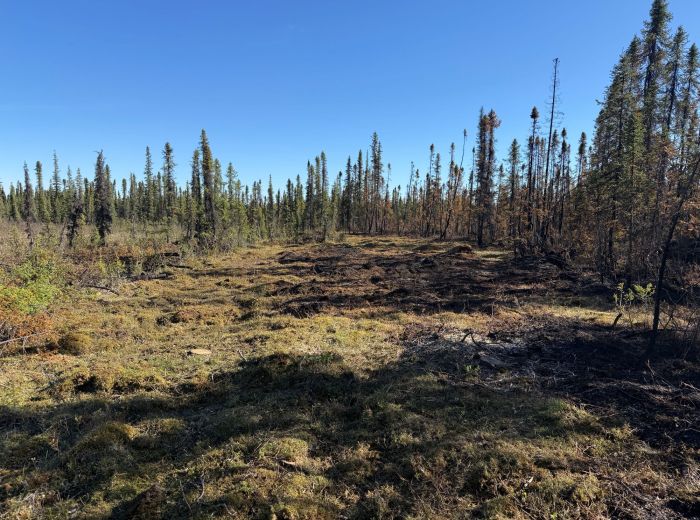
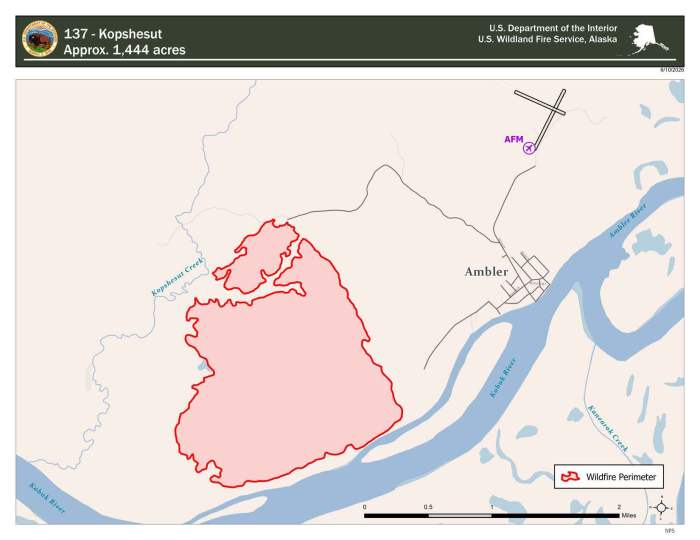
Firefighters are continuing to extinguish hot spots deeper within the Kopshesut Fire’s interior as favorable weather keeps fire activity subdued. A weather front moved into the area overnight, bringing clouds, cooler temperatures, and higher humidity. Containment remains at 50%, the level reached on Tuesday, and the fire footprint is still just under 1,500 acres. The fire is burning about one mile west of Ambler.
Firefighters are now focused on strengthening and securing the control line. Their goal is to eliminate all remaining heat up to 300 feet inside the perimeter before the fire can be declared contained and controlled.
U.S. Wildland Fire aircraft continue daily supply flights into Ambler, delivering supplies firefighters need on the line and backhauling equipment no longer required. Later this weekend and early next week, these flights will likely also transport personnel back to USWFS facilities in Galena and Fairbanks as work winds down. There are currently 57 personnel assigned to the incident, including 11 smokejumpers, the Midnight Sun Hotshots, and the North Star Fire Crew. It is one of only two staffed fires in Alaska.
Firefighters reported minimal fire activity on Wednesday, with one hot spot identified on the east flank, a few along the west side, and some lingering heat in the area that burned over the line on Saturday. Because remaining heat is mostly limited to surface fuels such as dry grass and black spruce, firefighters can identify and cool hot spots more efficiently.
Mop‑up involves carefully checking the burned area for any lingering heat that could ignite new fire activity. Firefighters dig out smoldering patches of grass, moss, duff, or material beneath fallen trees, apply water, and ensure the ground is cold to the touch. Fortunately, the fire is not burning deep into the soil layers, a situation more common later in the summer when deeper fuels dry out.
Ambler residents may notice more smoke coming from well inside the established perimeter when the weather warms in the future. This is normal and can occur even after a fire is considered contained or controlled. Smoke from interior hot spots deep inside the perimeter does not indicate that the fire is spreading beyond the reinforced control line.
PREDICTED WEATHER — A weather front moved through the area overnight, bringing cloudier skies, cooler temperatures, and higher humidity. These conditions are expected to continue through Friday. Southwest winds will still become gusty in the afternoon, with gusts up to around 20 mph. By Saturday, skies will start to clear and temperatures will warm again. Humidity levels could drop to around 30% on both Saturday and Sunday. Winds over the weekend are expected to stay fairly light.
AIR QUALITY — There is considerable concern about the noxious smoke produced by the burning material in the landfill where the fire began. Both wildfire smoke and smoke from burning trash contain fine particles and other pollutants that can be very harmful to people’s health. These particles can irritate the eyes and lungs and are especially dangerous for Elders, young children, and people with heart or respiratory conditions. Even short‑term exposure can worsen breathing problems. Residents should stay alert to changing conditions and take steps to protect their health if smoke moves into the community. Find more air quality information at https://dec.alaska.gov/air/anpms/wildfire-smoke/
For updated fire information, visit Alaska Wildland Fire Information (akfireinfo.com) and Alaska Fire Service on Facebook. Contact Public Affairs Specialist Beth Ipsen at Elizabeth_ipsen@ios.doi.gov or (907)356-5510 for more information.
-USWFS-
U.S. Wildland Fire Service, P.O. Box 35005 1541 Gaffney Road, Fort Wainwright, Ak 99703
Need public domain imagery to complement news coverage of the USWFS in Alaska? Visit our Flickr channel!
Learn more online, and on Facebook and Twitter.
Categories: AK Fire Info, US Wildland Fire Service

