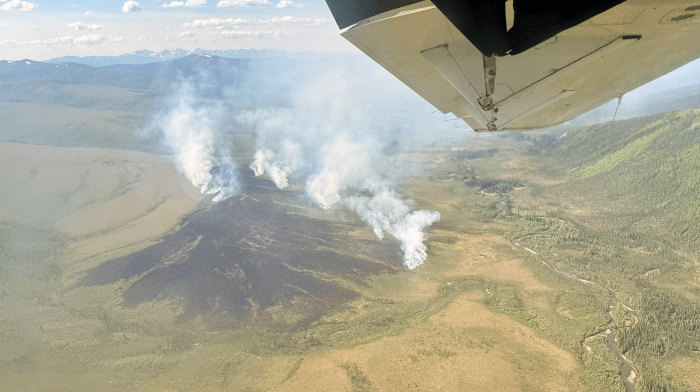
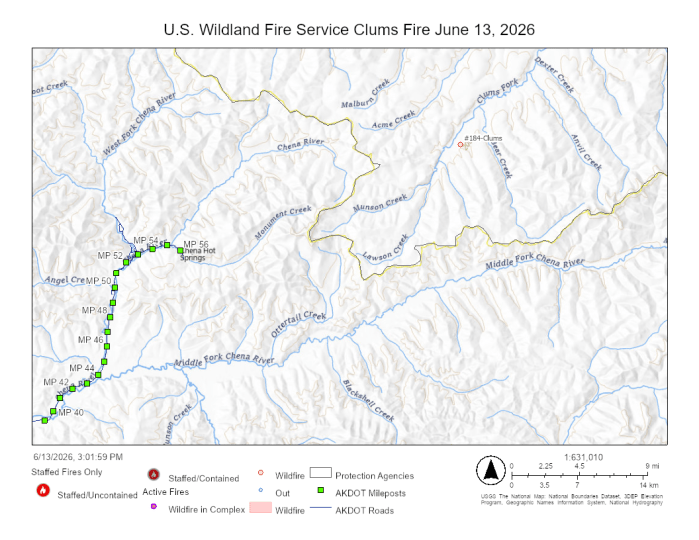
A strong U.S. Wildland Fire Service initial attack was launched on a rapidly growing, lightning‑caused wildfire located about 66 miles northeast of Fairbanks. The Clums Fire (#184) was reported around 8:30 a.m. Saturday and is estimated at 75 acres, burning primarily in tundra with pockets of black spruce. Earlier air support — including four single engine water scoopers and two Alaska Division of Forestry & Fire Protection air tankers —assisted initial suppression efforts. Eight smokejumpers remain on the ground and continue to work the fire with support from a helicopter conducting bucket drops. The air tankers were released while the water scoopers are standing by in case they’re needed to reengage.
The water scoopers first pulled water from the float pond at Fairbanks International Airport before moving to Medicine Lake, which is closer to the fire and near Circle Hot Springs.
The fire is burning on BLM‑managed land within the Steese National Conservation Area, roughly 20 miles east of the end of Chena Hot Springs Road.
This fire follows thunderstorms that moved across Interior Alaska Friday. More than 500 lightning strikes were recorded statewide, with the highest concentration in the Fairbanks North Star Borough and north into the Yukon Flats. Warm, dry, and windy conditions have followed these storms, raising concern for additional holdover fires.
The National Weather Service has issued a Red Flag Warning for the Yukon Flats from noon to 8 p.m. Sunday. Conditions are expected to become increasingly critical through the afternoon and early evening. Forecasts call for southeast winds of 10–15 mph with gusts up to 25 mph, humidity dropping to around 25%, and temperatures in the lower 80s. These factors, combined with dry fuels, create an environment where any new or existing fire could spread quickly.
Lightning often ignites wildfires immediately, but not always. Holdover fires can smolder unnoticed below the surface for days until warmer temperatures, drying vegetation, or gusty winds cause them to flare up. To stay ahead of these potential starts, fire managers conduct detection flights in the days following significant lightning activity to locate any sleeper fires before they grow.
Contact Public Affairs Specialist Beth Ipsen at Elizabeth_ipsen@ios.doi.gov or (907)356-5510 for more information.
-USWFS-
U.S. Wildland Fire Service, P.O. Box 35005 1541 Gaffney Road, Fort Wainwright, Ak 99703
Need public domain imagery to complement news coverage of the USWFS in Alaska? Visit our Flickr channel!
Learn more online, and on Facebook and Twitter.
Categories: Active Wildland Fire, US Wildland Fire Service

