U.S. Wildland Fire Service managers are expecting another active fire day in Western Alaska today. There were more than 9,000 lightning strikes across Alaska with more than 3,000 falling within the USWFS Galena Fire Protection Zone covering Western Alaska from the Yukon River north.
All new fires in Alaska — nine on Thursday and two Friday morning — occurred in USWFS’s 191.5-million-acre protection area covering most of northern Alaska. Three of those ignited in the Galena Zone, one of which generated a response from the USWFS.
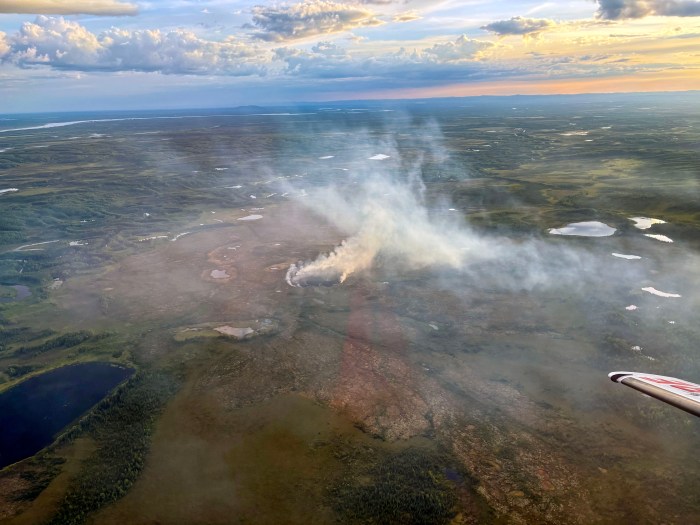
Twelve smokejumpers supported by four single-engine water scoopers responded to Whakatna Fire (#306) about 12 miles northeast of Galena on Thursday night. The fire was reported about 9:30 p.m. It was burning in tundra and black spruce north of Bear Creek in a Full protection area. Firefighters on the ground — aided by aerial water drops — kept the fire to about 8 acres. They set up a hose lay around the fire and put water on it until 2 a.m., when smoke was no longer visible.
Firefighters will improve the control line around the fire today and put out any remaining hotspots that could threaten the line.
Jade Fire (#285)
The Council of Athabascan Tribal Governments Type 2 Crew arrived in Ambler on Thursday to help suppress the Jade Fire (#285). The crew’s arrival allows fire managers to release some of the smokejumpers who have been fighting the fire so they can get ready to respond to any new starts. The CATG Crew is contracted by the USWFS through the Fort Yukon-based Council of Athabascan Tribal Governments.
The USWFS Midnight Sun Hotshots and 13 smokejumpers are still assigned to the fire, which is located about 5 miles west of Ambler. It is estimated at 67 acres with minimal growth occurring on Thursday. This morning, firefighters reported that the fire’s edge is relatively cool, but they are finding lingering pockets of heat inside the perimeter. They will improve the control line around the fire today by finding and extinguishing any hotspots near the edge in a process known as mop up.
The Jade Fire was reported on Tuesday by several people who saw a large column of smoke rising from an area past the landfill — the same location where the Kopshesut Fire originated on June 4. The fire has not reached the landfill.
PREDICTED WEATHER
Hot, dry, and windy conditions will remain in place for another day. Vegetation in the area is dry and getting drier. Given the current conditions, rapid fire growth is possible. Please avoid any outdoor burning and use caution with anything that can ignite a fire. Even a small spark can start a wildfire in these conditions.
The extended forecast predicts that showers and even a period of steady rain could move over the fire sometime Sunday afternoon or Sunday night and could linger into Monday.
AIR QUALITY
At this time, smoke from the Jade Fire has not significantly drifted into Ambler, but residents should stay alert to changing conditions and take steps to protect their health if smoke moves into the community. Find more air quality information at https://dec.alaska.gov/air/anpms/wildfire-smoke/. Both wildfire smoke and, if the Jade Fire reaches the landfill, smoke from burning trash contain fine particles and other pollutants that can be harmful to people’s health. These particles can irritate the eyes and lungs and are especially dangerous for elders, young children, and people with heart or respiratory conditions. Even short‑term exposure can worsen breathing problems.
For updated fire information, visit Alaska Wildland Fire Information (akfireinfo.com). Contact Public Information Officer Geoff Liesik at geoff_liesik@firenet.gov or (907) 356-5510 for more information.
Categories: Active Wildland Fire, US Wildland Fire Service

