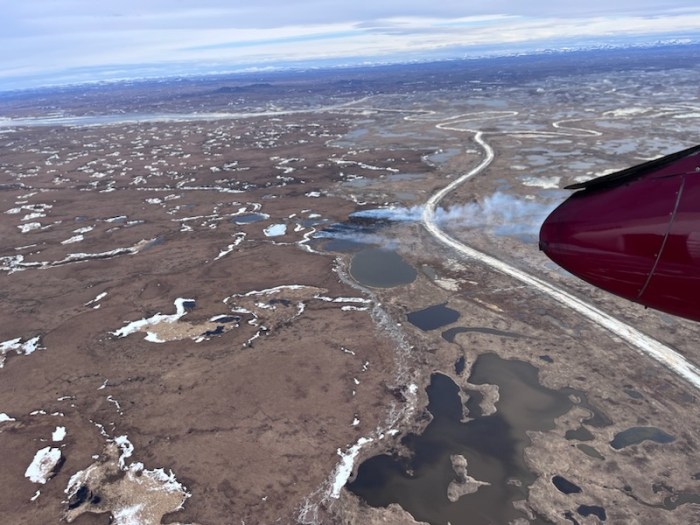
Fire Update for May 18, 2026 — The eight smokejumpers working on the Little Fire were able to keep it at 16.9 acres Saturday night. They then spent the next two days extinguishing hot spots, which were extensive due to the fire burning in driftwood. The fire was considered contained Sunday afternoon and declared controlled Monday morning. They anticipate demobilizing from the fire today.
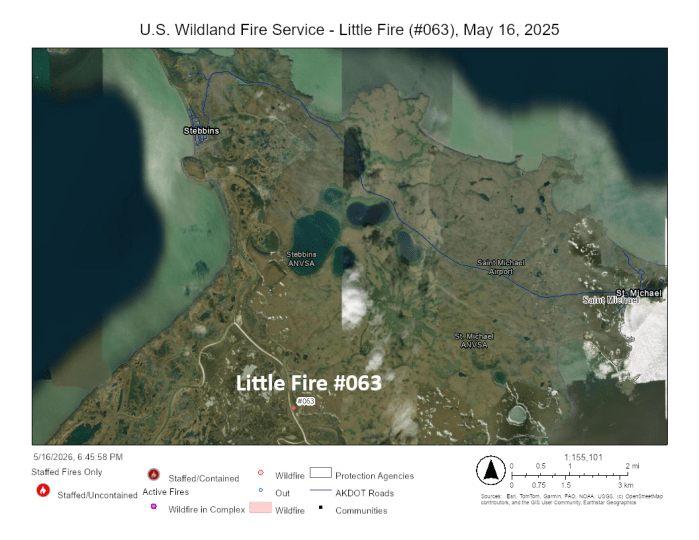
Original information from May 16, 2026 — Eight Alaska Smokejumpers responded to a new wildfire about 5 miles south of Stebbins on Saturday. The Little Fire (#063) was reported around 3 p.m. on the east side of the Little Saint Michael Canal. Two Native allotments are nearby — one a mile south across the canal and another 2 miles to the southeast.
This was the first fire jump of the 2026 Alaska Fire Season for U.S. Wildland Fire Service smokejumpers based at Fort Wainwright, roughly 450 miles away. When the aircraft arrived about two hours after the report, the fire was estimated at 10 acres, actively burning along about 75% of its perimeter in tundra fuels.
Alaska Smokejumpers are highly trained U.S. Wildland Fire Service firefighters who parachute to remote wildfires. They specialize in rapid response in areas that cannot be reached quickly by road, helping keep small fires from growing and protecting nearby communities.
By 6 p.m., the Little Fire was one of six new wildfires reported on Saturday. The other five occurred in populated parts of the Mat-Su Valley within the Alaska Division of Forestry & Fire Protection response area.
So far this season, 53 wildfires have been reported in Alaska, and all but five are believed to be human‑caused. The cause of the Little Fire remains undetermined.
During spring in Alaska, wildfire danger is high because the snowmelt exposes a lot of dead, dry grass that ignites easily. When green‑up begins, new leaves and fresh vegetation bring moisture back into the landscape. The added shade keeps the ground cooler, the plants hold more water, and the thicker vegetation slows the wind — all of which help prevent dried grass from heating up and burning.
However, even with these benefits, green‑up does not eliminate wildfire risk. Dead grass and other fine fuels are still present, and human‑caused fires can start anytime when people are careless with campfires, burn barrels, equipment, or sparks. Green‑up reduces natural fire potential, but safe behavior is still essential to prevent wildfires.
You can track Alaska wildfire activity on the Alaska Interagency Coordination Center Dashboard and explore distances, locations, fire history, lightning strikes, etc. using the AICC Wildland Fire Map Series.
Contact Public Affairs Specialist Beth Ipsen at 907-356-5510 or Elizabeth_ipsen@ios.doi.gov for more information.
-USWFS-
U.S. Wildland Fire Service, P.O. Box 35005 1541 Gaffney Road, Fort Wainwright, Ak 99703
Need public domain imagery to complement news coverage of the USWFS in Alaska? Visit our Flickr channel!
Learn more online, and on Facebook and Twitter.
Categories: Active Wildland Fire, AK Fire Info, US Wildland Fire Service

