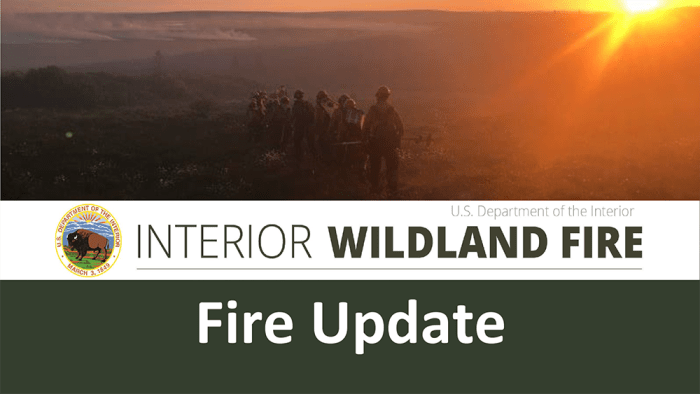
Firefighters took advantage of Sunday’s cooler, wetter weather to continue establishing control lines around a pair of wildfires near Ruby. Both the Big Fire (#313) and the Cecil Fire (#315) received consistent rainfall throughout the day. The fires are less than a mile apart and saw no growth Sunday. The Big Fire is estimated at 260 acres, while the Cecil Fire is estimated at 1,000 acres.
Two dozen smokejumpers and the Alaska Division of Forestry & Fire Protection Gannett Glacier Crew worked on the left flank of the Big Fire to secure the edge. They are working toward marshy areas that have naturally slowed the fire’s progression. Logistical aircraft will be used to move firefighters to areas of concern for additional line construction. Aircraft will also be used to ferry the U.S. Wildland Fire Service Midnight Sun Hotshots to the incident.
DFFP’s Pioneer Peak Hotshots and a dozen smokejumpers are working along the edge of the Cecil Fire, looking for remaining hotspots and extinguishing them. They will also continue to cut and expand control lines until they are able to get around the fire. The fire itself is in deep, thick black spruce stands, making work difficult and hazardous. Additional crews are being ordered to help with the heavy workload in this fuel type.
The weather today is expected to be cool with a chance of isolated rain showers. The main concern will be wind gusts up to 20 mph from the southwest. These winds will cause vegetation to dry out more rapidly in areas that do not receive rain today. It is still best to avoid any outdoor burning and use caution with anything that can ignite a fire. Even a small spark can start a wildfire in these conditions.
A Temporary Flight Restriction that covers the airspace above both fires has been lifted; however, areas where wildfires are being fought must be a No Drone Zone for the safety of firefighting air crews and people on the ground. A civilian drone spotted near a wildfire will temporarily ground all firefighting aircraft, halting their support for crews on the ground and elevating the risk to life and property. Remember, “If You Fly, We Can’t!”
For updated fire information, visit Alaska Wildland Fire Information (akfireinfo.com). Contact Public Information Officer Geoff Liesik at geoff_liesik@firenet.gov or (907) 356-5510 for more information.
Categories: Active Wildland Fire, US Wildland Fire Service

