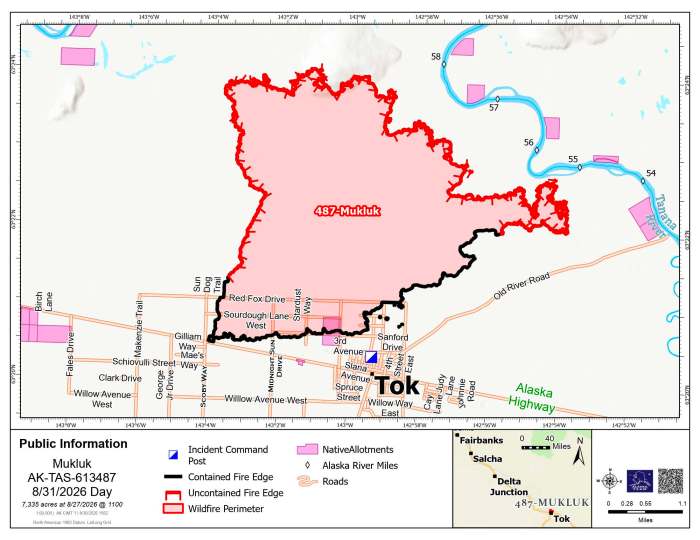
Acres: 7,335
Containment: 29%
Location: Tok, AK
Start Date: Aug. 17, 2026
Fuels: Black Spruce, Shrubs, Grass
Personnel: 235
Cold, wet, and blustery weather moves in on Monday as the Alaska Complex Incident Management Team concludes its final day managing the Mukluk Fire. The incoming Type 3 organization — made up largely of Alaska firefighting and support personnel — will shadow the Alaska CIMT on Monday before taking command early Tuesday morning. Many incoming team members have already been working with outgoing counterparts. Both teams are coordinating to ensure a smooth transition as the focus shifts to suppression repair.
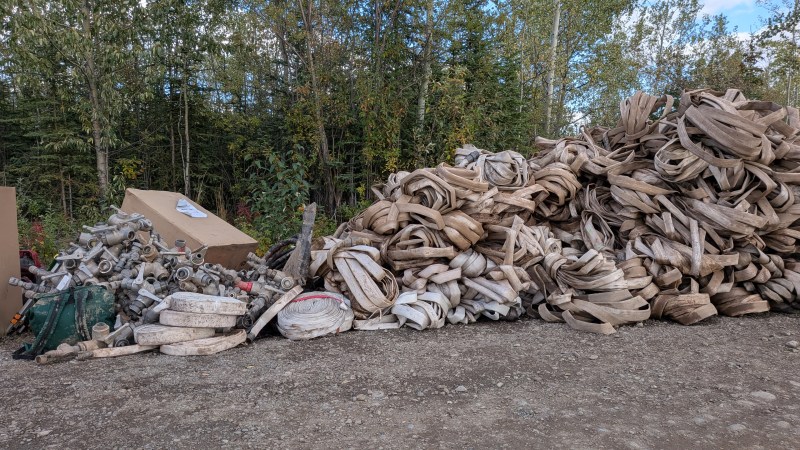
Some equipment has already been backhauled from portions of the fire, but key resources remain to support firefighters as they continue mopping up lingering hotspots and burning woody debris along the southern perimeter in Tok.
The response to protect Tok from the Mukluk Fire was truly an interagency and international effort, with support coming from both near and far. Firefighters responded quickly from Yukon, Canada. The U.S. Missoula Smokejumpers flew nearly 2,000 miles on Aug. 18 to make an initial‑attack fire jump after all available Alaska Smokejumpers were committed to the fire. Nearby engines and crews responded from Tok and other Interior communities like Anderson, Delta Junction, and Fairbanks as well as more distant areas, including but not limited to Anchorage, Girdwood, and the Mat-Su Valley, whose personnel spent nights patrolling fire‑impacted neighborhoods. Additional crews traveled from Fort Yukon (CATG Fire Crew), Selawik in northwestern Alaska (Nulato Hills Fire Crew), Southwest Alaska (Chevak Module), and the local Tanana Chiefs Fire Crew. Alaska crews were called back from the Lower 48 along with two additional Hotshot crews from California.
Residents in fire‑impacted areas are urged to use caution around any remaining debris. Burned structures, vehicles, and materials may contain ash, sharp metal, chemicals, and other hazardous substances. If you need to enter or work around these areas, protect yourself with sturdy footwear, gloves, long sleeves and pants, eye protection, and respiratory protection such as an N‑95 mask when appropriate.
The Alaska Division of Forestry & Fire Protection (DFFP) is extending fire season in the Delta, Tok and Copper River protection areas due to continued dry conditions and an increased risk of wildland fire. The extension begins Tuesday, Sept. 1, and continues through 11:59 p.m. Monday, Sept. 14.
Weather & Fire Behavior: A cold front will move into the area Monday morning, bringing northwest winds that will strengthen through the day, with gusts up to 40 mph. These winds may push over trees in several parts of the fire area. Rain is likely with this system, though it’s unclear whether it will be enough to penetrate the upper layers of the duff.
Mukluk Fire Information:
Information Line: (907) 505-0362 – Hours: 8 a.m. – 8 p.m.
Email: 2026.Mukluk@firenet.gov
For more information: https://linktr.ee/2026MuklukFire
Download a PDF version of the update.
Categories: AK Fire Info

